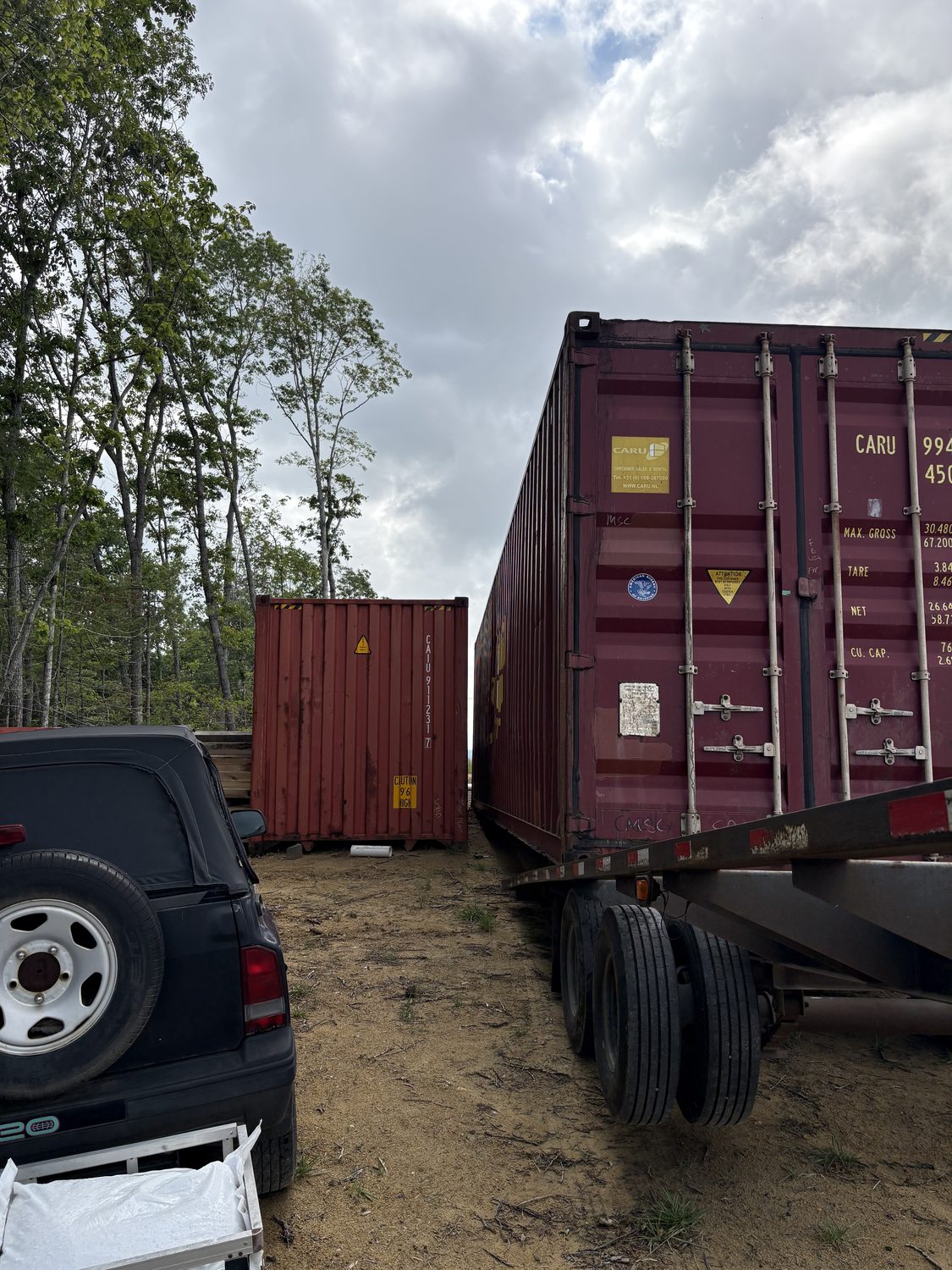
The most useful thing we can tell you about delivery cost is that for most of the people reading this, it is zero. Delivery and leveling are free within 75 road miles of our Woodlawn yard, and that figure is not a promotion or a starting point. It is how our prices are built.
This page is about what happens on either side of that line. Inside it, why the haul is already in your number and what that includes. Outside it, what actually decides the quote, which is rarely the mileage and almost always the last two hundred feet.
Inside the zone, delivery is already paid for
Every price we publish is an out the door number. The drive, setting the container down, leveling it on blocks and the welded lockbox are all inside the figure before you ever ask about delivery.
So a used cargo worthy 20 ft container at $3,200 delivered anywhere inside 75 road miles is $3,200. A used cargo worthy 40 ft at $4,900 is $4,900. There is no delivery line waiting at the end of the conversation, which is the single most common thing people are braced for when they call a container yard.
That ring covers most of the tri state area we serve. Hillsville is about 8 miles out, Galax about 15, Wytheville about 32, Floyd about 35, Dublin and Radford about 50, North Wilkesboro about 52, Blacksburg and Martinsville about 60, Marion about 62. All of it rides free.
Of the towns we quote regularly, only Roanoke at about 76 miles and Bristol at about 88 fall outside, and both are close enough that the delivery line stays modest. You can see the whole picture on our service area page.
What distance actually costs
We run flatbeds well beyond 75 miles, and the quote past the ring is straightforward arithmetic rather than a penalty. It is a truck, a driver and fuel for the extra road, in both directions.
Two things about that are worth knowing before you ask.
It is a round trip
The truck has to come home. A delivery twenty miles past the ring is forty miles of additional running, not twenty, and that is why the numbers move faster than people expect once you are properly outside the zone.
Route matters more than map distance
This is mountain country. Two addresses the same straight line distance from Woodlawn can be a very different drive depending on whether the route is interstate or a two lane road over a ridge. We quote on the actual route a loaded flatbed can take, not on a radius.
If you are outside the ring, give us the delivery address rather than the town. The difference between one side of a county and the other is sometimes the difference between an easy run and a slow one.
The last two hundred feet decide everything
Here is the part that surprises people. Access affects a delivery quote more often than distance does, and it is the single most common reason a delivery gets complicated on the day.
Containers are delivered on a tilt bed trailer. The trailer backs in, tilts, and slides the container off onto your ground while the truck pulls forward. That means the truck needs a straight, clear pull in behind where the container will sit, and it needs a fair bit of it.
- About 65 feet of straight pull in for a 20 ft container. That is clear space behind the final position, in line with it.
- About 95 feet for a 40 ft container. This is the one that catches people with a container sized for the space it will occupy rather than the space it takes to place.
- Overhead clearance the whole way in. Low branches, power and phone lines, and building overhangs all stop a tilt bed before a narrow gate does.
- Width for the truck, not the container. A gate a container would fit through is not necessarily a gate a truck and trailer can turn into.
None of this is unusual on a normal driveway or a field entrance. It becomes a cost when the site needs a different approach, and that is what we are working out when we ask about access rather than just the address.
| What we need | 20 ft container | 40 ft container |
|---|---|---|
| Straight pull in behind the spot | About 65 feet | About 95 feet |
| Overhead clearance the whole way | Clear of limbs, power and phone lines | Clear of limbs, power and phone lines |
| Ground under the truck | Firm enough for a loaded flatbed | Firm enough for a loaded flatbed |
| Ground under the container | Level enough to block and level on | Level enough to block and level on |
| Delivery inside 75 road miles | Already in the price | Already in the price |
Measured behind the final position, in line with it, not from the road.
What the container has to land on
The ground does two separate jobs. It has to carry a loaded truck coming in, and it has to hold a container level once the truck leaves.
Carrying the truck
A tilt bed with a 40 ft container on it is heavy, and soft ground is what turns a twenty minute delivery into a recovery. Saturated fields in spring, fresh fill that has not settled, and new gravel that has not been compacted are the usual culprits. Frozen ground is usually excellent, which is why winter deliveries into fields are often easier than summer ones.
Holding the container
We level on blocks as part of the delivery, and that handles ordinary variation in a yard or a field. What it does not handle is significant slope or ground that will move seasonally. A container that is not sitting true is a container whose doors gradually stop lining up, and doors that do not line up are the thing you notice every day.
Obstacles are the rest of it. Septic fields and leach lines, shallow utilities, wells, irrigation, culverts and soft shoulders all affect where a truck can drive and where a container can sit. Tell us what is under the approach if you know, because a driver finding out on the day is the expensive version.
When a tilt bed is not the answer
Most deliveries are a tilt bed and nothing else. A few are not, and those are the ones with a genuinely different number attached.
- Crane placement. When a container has to go somewhere a trailer cannot back to, over a fence, between buildings, onto a prepared foundation, it gets lifted rather than slid. That is a separate piece of equipment and it is quoted as one.
- Repositioning on site. Moving a container that is already on your ground is its own trip, even if it is only going thirty feet.
- Multiple containers. Several boxes to the same address on the same day share the trip and the arithmetic works in your favour.
- Return trips. Rentals get picked up at the end of the term, and the same access questions apply on the way out as on the way in.
That last point is worth flagging for anyone renting. A site that has grown up around a container over eighteen months, with a new deck, a fence, or a tree that was smaller when it arrived, is a site the truck may not be able to reach anymore. It is worth a look before the pickup is booked.
The way to get an accurate delivery number is simple: tell us the delivery address, the container size, and roughly what the approach looks like. Quotes come back the same day, and if there is an access problem we would rather find it in the conversation than in your driveway.