Most people who call us have never thought about permits, and there is no reason they should have. You needed storage, a container is dry, secure space you can set on a piece of ground, and the price made sense. Then a neighbor or a coworker asks whether you are even allowed to do that, and a simple purchase suddenly has a question sitting in the middle of it.
This is the plain language version of the answer for the three states we deliver into. It is not a legal opinion, and it cannot tell you what your particular parcel allows, because no page on the internet can do that honestly. What it can do is show you the shape of the landscape, so that when you call your county office you already know which questions you are asking and what the words mean.
There are two separate questions, and people mix them up
Nearly all the confusion here comes from treating this as one question when it is really two, asked by two different offices working from two different rulebooks.
The first is the building code question: is this thing a structure that has to be built and inspected to construction standards. That code is written at the state level and enforced by a local building official.
The second is the zoning question: is this use allowed on this particular parcel, and where on the parcel can it sit. That one is written locally, by a county or a town, and it is where setbacks, screening, district rules and time limits live.
A state can answer the first question with a clean exemption and say nothing at all about the second. That is exactly what Virginia does, and it is the most common reason somebody tells us confidently that no permit is needed anywhere in the state. The building code may well leave your storage container alone. Your county still gets a vote on where it goes.
Virginia: a statewide exemption, for storage use
Virginia answers the building code question directly, and it is written down where you can read it. The Uniform Statewide Building Code, at 13VAC5-63-20, Section 102.3 Exemptions, item 11, exempts "Off-site manufactured intermodal freight containers, moving containers, and storage containers placed on site temporarily or permanently for use as a storage container" from the building code.
Two details in that sentence matter. The first is temporarily or permanently, which means the exemption does not run out and does not care whether the box leaves in six months or sits there for twenty years. The second is for use as a storage container, which is the condition the whole thing hangs on.
So a container holding mowers, tools, feed, inventory or household goods is normally outside the building code in Virginia. The moment the plan is an office, a finished shop or anything a person occupies, you are no longer describing a storage container, and that is a conversation to have with your building official before you spend money on a buildout. The state level detail is in the Virginia container permit guide.
The state code is not your county
This is where Virginia stops being simple. Zoning is local, and Virginia localities differ from each other about as much as two states would.
Some counties have no countywide zoning at all. Wythe County, the county our Wytheville sales lot sits in, is one of them, which surprises people who assume every parcel in America is zoned something. Other localities run detailed ordinances that speak directly to containers: which districts allow them, how far they must sit from a property line or a road right of way, whether one is allowed in a front yard, how many a parcel may hold, whether screening is required, and whether a jobsite container counts as temporary and is tied to an active building permit.
Towns add a layer. A parcel inside town limits usually answers to the town first, and town rules are often tighter than the county's. Homeowner associations are not government at all, but their covenants can still forbid a container the county would happily allow. For a worked example of what a county with no zoning really means, read containers in Wythe County.
North Carolina: assume a permit until told otherwise
North Carolina runs the other direction, and the reason is a measurement. State law exempts small accessory structures from the building code at GS 160D-1110(c): a one-story accessory building used for residential storage, not exceeding 12 feet in any dimension, and not on a permanent foundation.
That exemption is real and useful, and it does not reach the containers we deliver. Every container we sell, 20-ft or 40-ft, is longer than 12 feet on its long side, so it fails the test before you get to the rest of the sentence.
The practical result is a different default. In North Carolina, plan on a building permit for a container on a residential property unless the jurisdiction you are actually in tells you otherwise, and local practice does vary from one county to the next. That is worth a phone call rather than an assumption in either direction, and the detail is in the North Carolina container permit guide.
West Virginia: adoption is a county choice
West Virginia is harder to summarize, because building code adoption is itself optional at the county level there, so what applies depends on choices your county made rather than on one statewide rule. That state gets its own guide, and until then the phone call to the local office matters more there than anywhere.
Your first call, and what stays with you
One call to the county building or zoning office is the way to settle this for your parcel, and it is the only answer that actually counts. Have your address or parcel number in front of you, say plainly that you are placing a storage container, give the size, and work down this list:
- Is this parcel zoned, and if so, what district is it in.
- Is a storage container a permitted use there, an accessory use, or something needing a special exception.
- What setbacks apply from property lines, from the road right of way, and from a septic tank or drainfield.
- Do you need a zoning permit, a land use clearance, a building permit, or nothing at all.
- Are there screening, color or placement rules, such as keeping it out of the front yard.
- Is there a time limit if the container is temporary and tied to active construction.
- Is any part of the property in a mapped floodplain, and if you are inside town limits, ask the town all of the above too.
Write down who you spoke with and the date. If a permit is required, having it in hand before the container arrives is a great deal easier than sorting it out after the box is already sitting on the ground.
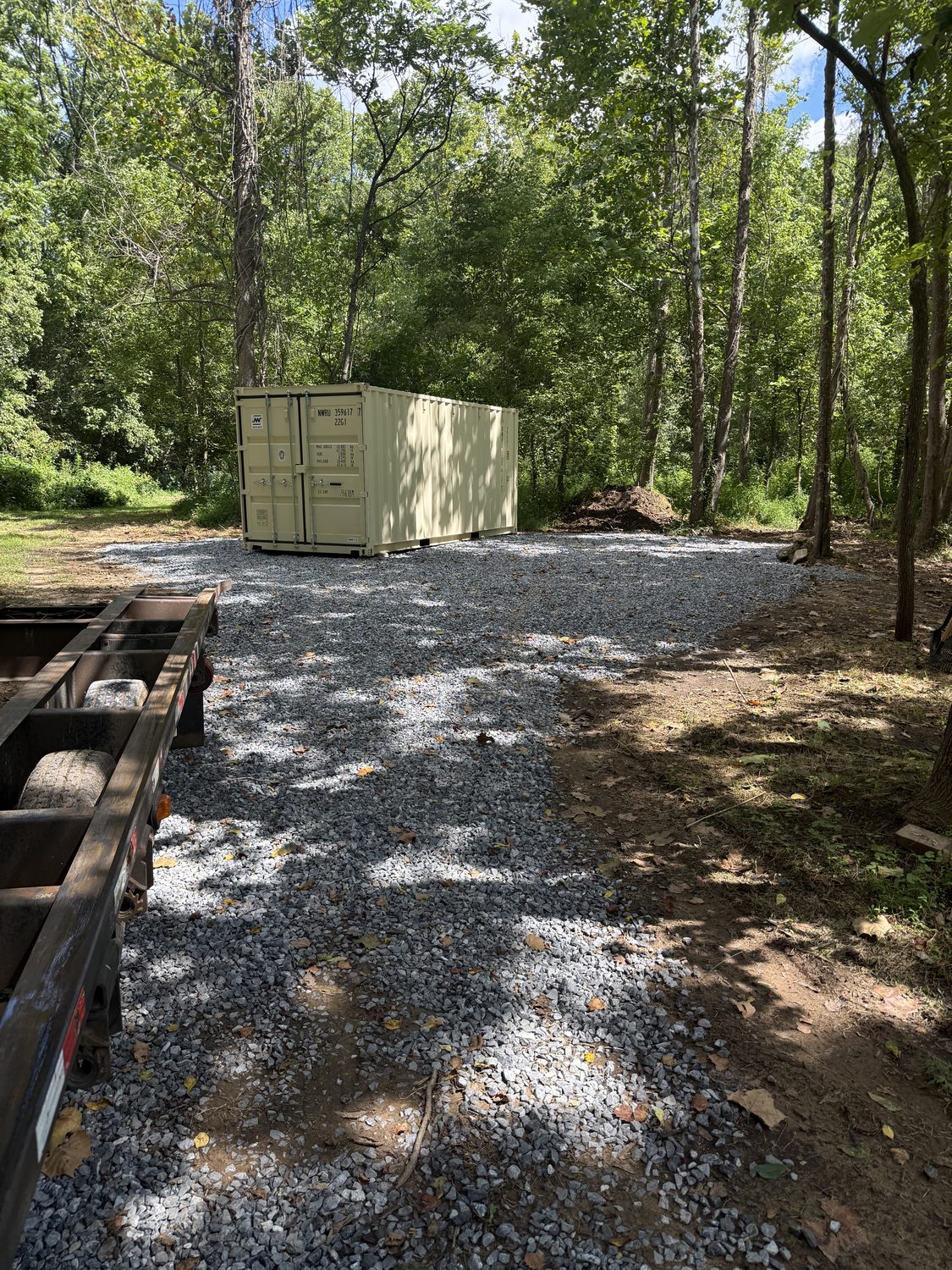
Our half of the job is the steel and the setting. The container arrives on a tilt-bed trailer and slides off onto the spot you picked, and we level it on blocks as part of the delivery, free within 75 road miles of the Woodlawn yard. What the site needs is about 65 feet of straight, clear pull-in for a 20-ft container and about 95 feet for a 40-ft, ground firm enough to carry a loaded truck, and clear overhead the whole way in, which matters more than gate width. Significant slope is a phone conversation before the truck is loaded.
The permitting and zoning question stays with the property owner. We do not pull permits and we do not file zoning applications. We are glad to talk through what we have run into in your area, and then you get the official answer from the office that decides. Call us at (276) 237-6144 once you know where the box can sit.