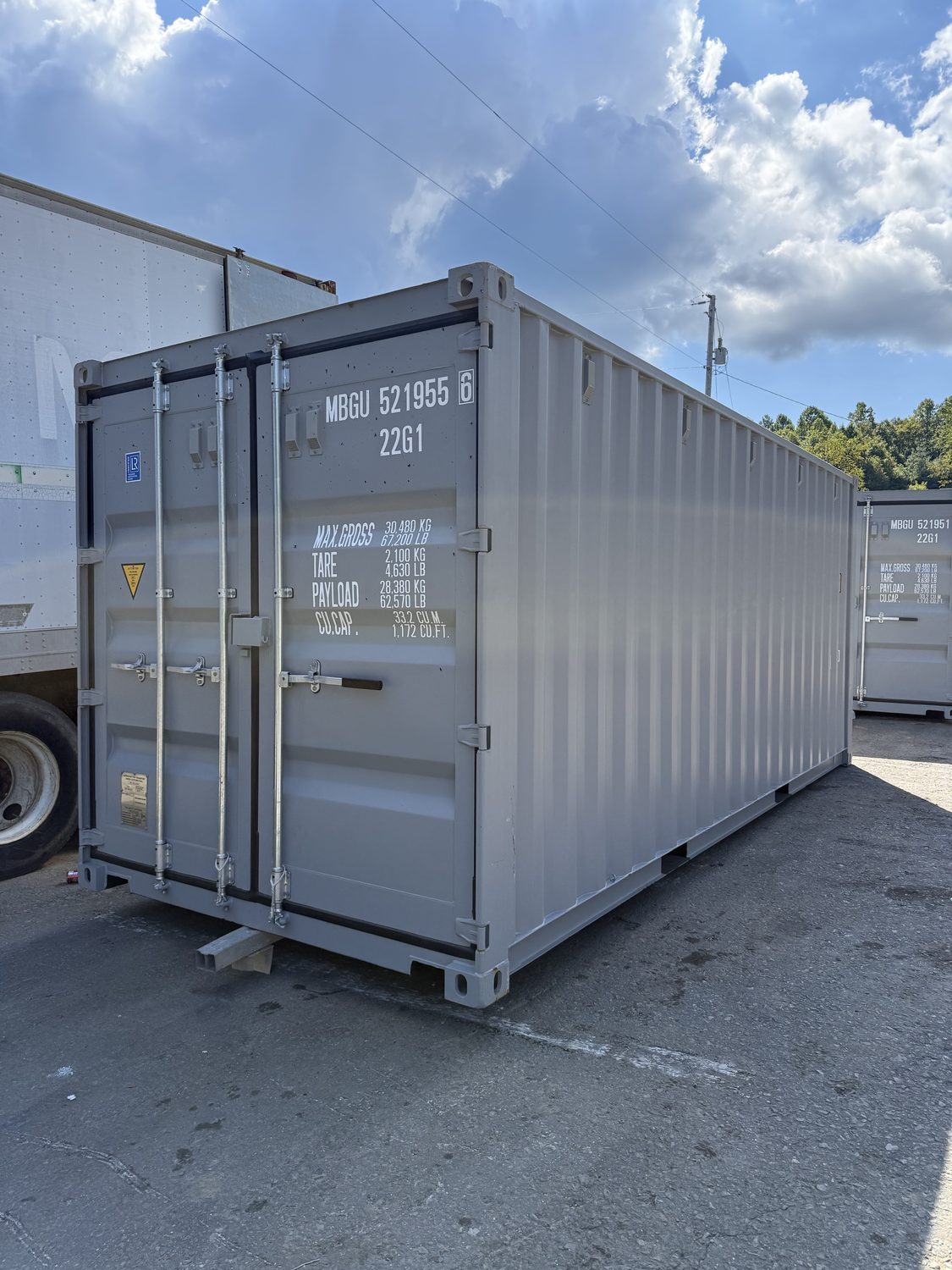
If you are buying or renting a shipping container in Virginia and you want to know whether you need a building permit to set it on your property, the statewide answer is clearer than most people expect. The Virginia Uniform Statewide Building Code writes storage containers into its list of exemptions by name. As long as the box stays a box, meaning you are storing things in it rather than living or working inside it, the state building code is not the thing standing between you and a delivery.
The part that actually varies is zoning, and zoning is not a state matter. Every county, town, and city in Virginia sets its own rules on setbacks, accessory structures, how many containers a parcel can hold, and whether a container is a permitted use in your district at all. Some localities in our service area have detailed ordinances with screening and placement language. Others, including the county our Wytheville sales lot sits in, currently have no countywide zoning on the books. Those two situations feel identical from the driveway and are completely different on paper.
This guide separates the two questions so you know which one deserves your morning. Below is the plain reading of the regulations, the exact point where a container stops being exempt storage and becomes a permitted building project, and the short list of questions worth asking your locality before we load the truck.
Virginia's building code exempts storage containers, in writing.
The relevant citation is 13VAC5-63-20, Section 102.3, the exemptions section of the Virginia Uniform Statewide Building Code. Item 11 on that list covers, in the regulation's own words, off-site manufactured intermodal freight containers, moving containers, and storage containers placed on site temporarily or permanently for use as a storage container. That is not an interpretation somebody in the industry came up with. It is the text of the regulation, and it names our product category three different ways so there is no argument about what an intermodal freight container is.
Two words in that sentence carry a lot of weight. The first is temporarily or permanently. The exemption does not run on a clock. A container you set behind the shop and never move again is exempt on the same terms as one that sits on a jobsite for six weeks. People often assume there is a ninety day rule or a one year rule somewhere in Virginia law that flips a storage container into a permanent structure requiring review. There is not one in the USBC exemption text, and the phrase covering permanent placement is the reason.
The second is for use as a storage container. That clause is the whole hinge of the exemption. The code is not exempting the object, it is exempting the use. Keep the use to storage and the exemption holds. Change the use to something people occupy, and you have left the exemption behind entirely, which is the subject of a later section on this page.
There is a companion regulation, and it says the same thing.
People who go looking for the rule sometimes find a second one and get nervous, so it is worth explaining why two regulations touch the same product. Virginia also maintains the Industrialized Building Safety Regulations, which govern buildings and building components manufactured in a factory and then shipped to a site. On its face that description sounds like it could swallow a shipping container, since a container is unquestionably built somewhere else and trucked in finished.
The regulation closes that door on purpose. 13VAC5-91-20(E) separately exempts the same category of intermodal freight, moving, and storage containers from the Industrialized Building Safety Regulations when the container is used for storage. So both places a Virginia official might reasonably look, the building code and the industrialized building rules, land in the same spot for a storage box.
What that consistency buys you is a straight answer that travels. Because both citations are state level regulations, they read identically in Bristol, in Winchester, in Virginia Beach, and in every county line between them. A building official in one part of the state is working from the same exemption text as a building official four hours away. This is the one part of the container permit question where Virginia gives you a uniform answer, and it is worth knowing which part that is before you start making calls.
- 13VAC5-63-20, Section 102.3, item 11 exempts storage containers from the Uniform Statewide Building Code.
- 13VAC5-91-20(E) exempts the same containers from the Industrialized Building Safety Regulations when used for storage.
- Both are state regulations, so the exemption reads the same in every Virginia locality.
- The USBC exemption text covers placement temporarily or permanently, so it carries no time limit of its own.
The line the code cares about is storage versus occupancy.
Since the exemption attaches to the use rather than to the steel, the practical question becomes where storage ends. The dividing line is occupancy, meaning whether the space is intended for people to be inside it in the way they are inside a building. A room people work in, sleep in, receive customers in, or spend the day in is an occupied space, and occupied spaces need code compliant egress, light, ventilation, electrical, and often plumbing and thermal envelope work. That is what a building code exists to regulate.
Ordinary storage does not raise any of those questions. Tools, mowers, tractor implements, feed, seasonal inventory, jobsite materials, business records, furniture during a renovation, equipment for a rental fleet, none of that changes the character of the box. Neither do the practical things people add so their storage works better. Shelving along the walls, a plywood floor liner, passive roof vents to cut condensation, a ramp at the doors, and a coat of paint are all consistent with a container being used as a container.
Where it gets genuinely gray is the in between build. A container with a man door, a window, insulation, and a couple of receptacles might be a well finished storage shed or it might be a small office, and which one it is depends on how it will actually be used rather than on what got installed. That is a conversation for your local building official, not for us and not for a website. When customers ask us to guess, we tell them the same thing every time: describe the finished use to your building department in one honest sentence and let them tell you which side of the line they put it on.
Convert a box into a room and section 3115 shows up.
Once a container is converted for occupancy, the exemption is behind you and the Virginia Construction Code takes over. The provision to start with is section 3115, the industrialized building provisions that cover modified and occupied shipping containers. That section is the reason a container office, a container break room, or a container dwelling goes through a permit process the way a stick built structure would. There is nothing exotic about that process, but it is a real one with drawings, review, inspections, and a local building department on the other end of it.
If a conversion is what you are after, call your local building department before you buy the container, not after. What they tell you about foundation, anchoring, egress, and inspection sequencing will shape the build, and it is far cheaper to hear it at the beginning. We are happy to be on that call with you if it helps to have someone who can answer questions about the box itself.
On the fabrication side, everything we do is built in house at the Woodlawn shop. We cut, weld, wire, and finish, and we keep a library of twelve mod types covering the work customers ask for most. Insulation is either spray foam or rigid panel, finished over so you are not looking at bare foam. Electrical is roughed in only, which is deliberate: a licensed electrician does the final hookup and the inspection, and we do not pull electrical permits. If you already own a container and it is sound and wind and water tight, we will modify yours.
Every modification job gets a written, itemized quote before any steel is cut, so you can see exactly what you are paying for line by line. We do not publish modification pricing, because no two builds are the same and a number on a web page would be a number for somebody else's project. Call the shop at (276) 237-6144, describe what you have in mind, and we will put a real quote in writing.
Zoning is a separate question, and it is the local one.
Here is the distinction that saves people the most trouble. The building code exemption tells you the state does not require a building permit to place a storage container. It says nothing at all about whether your locality's zoning ordinance allows a container on that parcel, in that spot, in that quantity, or in that district. Building code and zoning are two different bodies of rules administered by two different offices, and passing one has never meant passing the other.
Zoning in Virginia is set locally, and the variation is enormous. A county with a full ordinance may address several of these at once, while the next county over addresses none of them because it has no countywide zoning at all. Wythe County, the county our Wytheville sales lot sits in, currently sits in that second group, which is a useful reminder that a neighbor's experience is not evidence about your parcel. Towns inside a county frequently have their own ordinance that is stricter than the county's, so the question is not just which county you are in, it is whether you are inside town limits.
- Whether a storage container is a permitted accessory use in your zoning district at all.
- Setback distances from property lines, road right of way, wells, septic fields, and streams.
- Limits on the number, total square footage, or height of accessory structures on a parcel.
- Screening, placement, or paint and condition requirements, more common in residential and commercial districts than agricultural ones.
- Time limits on containers used as temporary jobsite storage, which are sometimes tied to an active building permit.
- Whether a zoning permit, a land disturbance permit, or a floodplain review is triggered by the placement itself.
Separate from anything the government does, private restrictions can apply. Homeowner association covenants, subdivision deed restrictions, and lease terms on rented land are enforced by private parties, not by the county, and a zoning office will not check them for you. If your property is in a platted subdivision or under an HOA, read those documents before you order.
One phone call to your zoning office answers most of this.
For the overwhelming majority of our customers this is a ten minute phone call, not a project. Find your county or city planning and zoning office, tell them the parcel address or tax map number, and say plainly that you want to place a shipping container for storage. Zoning staff field this question constantly and they will usually give you a straight answer on the spot.
- Is a storage container a permitted accessory structure in this zoning district?
- What are the setbacks I have to hold from the property lines and the road?
- Is there a limit on how many accessory structures or how much accessory square footage this parcel can have?
- Do I need a zoning permit or any paperwork filed before it is delivered?
- Are there screening, placement, or condition requirements I should know about?
- Is this parcel inside town limits, and if so whose ordinance applies?
- Is any part of this parcel in a mapped floodplain?
Two habits make that call worth more later. Write down the name of the person you spoke with and the date, and if the answer matters much, ask them to send you the same thing in an email. Staff turn over, memories fade, and a two line email from the zoning office is the cheapest insurance available in this whole process. If they tell you a permit is required, ask what it costs and how long review takes, because that answer decides your delivery date, not our schedule.
County by county, because Virginia is not uniform.
Because the state answer is settled and the local answer is not, we are building out permit guides one locality at a time across the area we deliver to. Each one covers what we have been able to confirm about that locality's zoning posture on containers, which office to call, and anything unusual worth knowing before a truck rolls. The guide at /permits/wythe-county-va/ is the most detailed, partly because Wythe County is where our Wytheville sales lot sits and partly because a county with no countywide zoning makes a clean case study in how different the local layer can look from the state layer.
You can see the full set of published guides at /permits/. We add localities as we verify them rather than publishing a guess, so if yours is not up yet, that is why. Call the yard and we will tell you what we know about that county from recent deliveries, and we will tell you plainly when we do not know.
One important caveat for customers outside Virginia. We deliver into North Carolina and West Virginia as well, and the Virginia exemption text above is Virginia law. It does not travel across the state line. Both of those states run their own building codes with their own exemption language, and their county and municipal zoning is just as local as Virginia's. If your delivery address is in North Carolina or West Virginia, do not rely on the citations on this page. Ask the building department in that jurisdiction directly.
Permits aside, the site still has to take the truck.
Paperwork is only half of getting a container onto a property. The other half is physical, and it is the half that actually stops deliveries. Containers arrive on a tilt-bed trailer, which sets the box by tilting the deck and easing the container off as the truck pulls forward. That means the truck needs a straight, clear run to place it, roughly 65 feet of pull-in for a 20-ft container and roughly 95 feet for a 40-ft.
Overhead clearance along the entire route in matters more than gate width, and it is the thing people forget. Low limbs, power and service drops, carport overhangs, and barn door headers all have to clear the raised deck, not just the container sitting flat. Ground conditions matter too. The path and the set spot need to be firm enough to carry a loaded truck without rutting or sinking, which in wet months can mean waiting a few dry days or laying stone.
We level the container on blocks as part of the delivery, so a modest grade is routine. Significant slope is a phone conversation before we load, because the fix is sometimes a different set spot and sometimes a little site work on your end. Send a photo of the approach and the spot when you call and we can usually tell you in a minute whether it will work.
The bottom line for a Virginia property owner.
Strip away the citations and this comes down to three sentences. If you are storing things in an unmodified container, Virginia's building code is not your obstacle, because the exemption names your use in the regulation text and puts no clock on it. Your county or city zoning office is the one call worth making before delivery, because that is where the real variation lives and where a five minute conversation prevents an expensive relocation. And if you want to turn a container into a livable or occupied space, that is a genuine permit project, section 3115 of the Virginia Construction Code is the starting point, and your local building department should hear about it before you buy anything.
- Storing things in an unmodified box: state building code exemption applies, no building permit for the placement.
- Any placement anywhere: check local zoning, plus any HOA or deed restrictions, before the delivery date.
- Converting to occupied space: permit process applies, start with VCC 3115 and your building department.
- Outside Virginia: the citations on this page do not apply, ask that state and locality directly.
One honest disclaimer, because it matters. We sell and deliver containers, we are not attorneys and we are not your code official. Everything on this page reflects our reading of the current regulation text and our day to day experience delivering across this region, and regulations do get amended. The authority on your property is the building official and zoning administrator with jurisdiction over your parcel. When their answer differs from anything here, theirs is the one that counts.
If you would rather just talk it through, call the yard at (276) 237-6144. Tell us the county and what you plan to put in the container, and we will tell you what we have run into there, what your site probably needs, and what we can get out to you. We also run a rent-to-own program, and in many cases we can credit a portion of what you have already paid toward the purchase price. The specific terms on that are a phone conversation rather than a web page, so ask when you call.