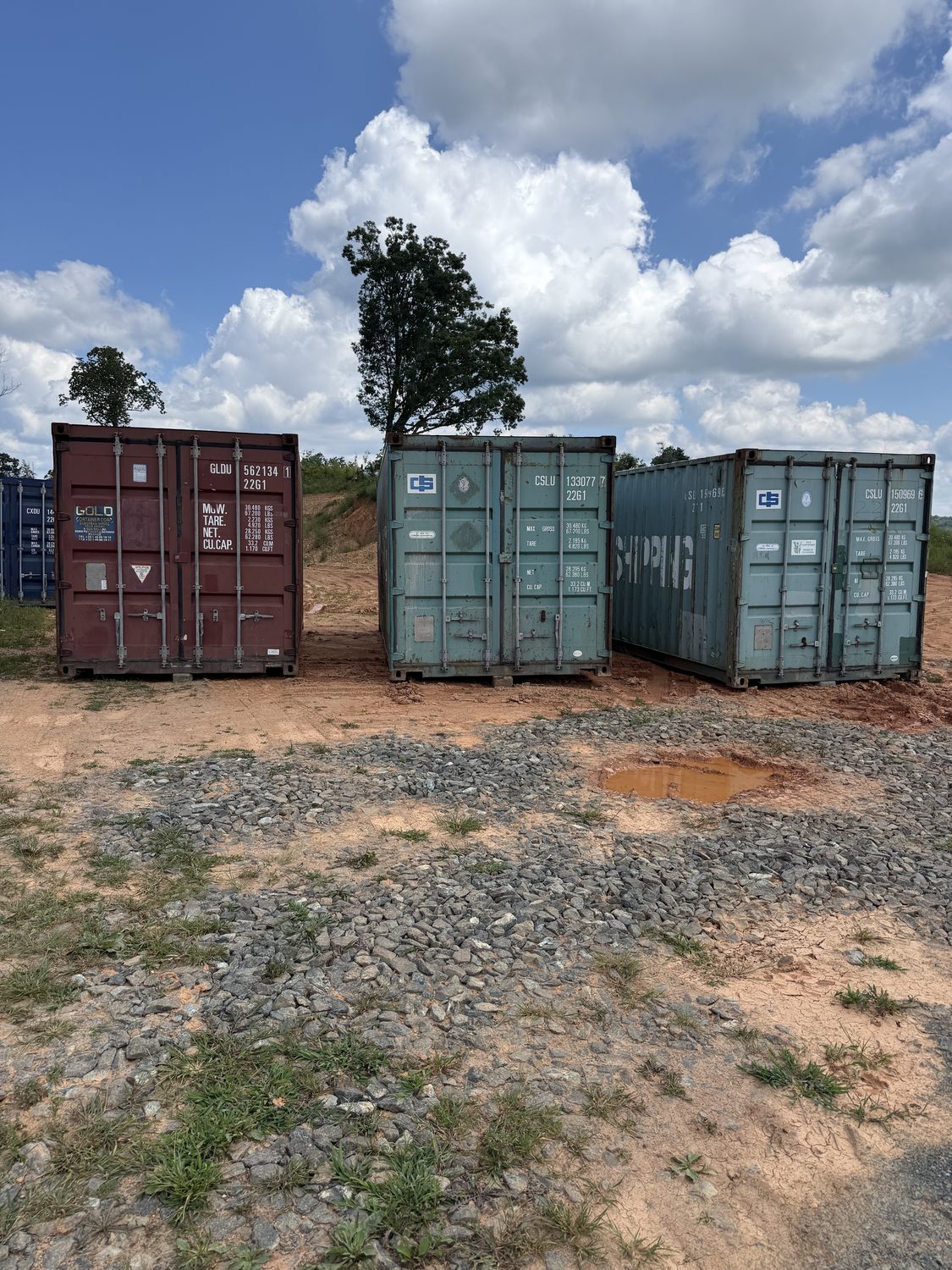
Patrick County gets summarized in a phrase that is almost right, and the incomplete part of it is the part that costs somebody money.
The accurate version, in the comprehensive plan's own terms: there is no countywide zoning ordinance in Patrick County. Three narrow site-specific zoning ordinances do exist, the Town of Stuart is fully zoned with its own map and administrator, and the county has an adopted floodplain ordinance whose own definition of development reaches stored materials and other structures.
So for a locked steel box on unincorporated acreage outside a mapped floodplain, there is almost nothing to file. On a parcel along the Smith River, the headwaters of the Dan, or Philpott Lake, it is a call with the county Building Official before anything gets set. Here is both, with the offices named.
What the county says about its own land use controls
The sentence to have in front of you is from Chapter 11, Land Use, of the Patrick County Comprehensive Plan dated January 21, 2022: Land use controls in the County are somewhat limited, as there is no countywide zoning ordinance, with exceptions being the Town of Stuart, forestry zoning along a 3.7-mile segment of Route 822 (Goose Point Road), and site-specific zoning ordinances at Patrick County Business Park and Rich Creek Corporate Park.
Zoning here is the exception, and every exception is geographic:
- The Town of Stuart, the county seat, which adopted a zoning ordinance in December 2007 and updated it in September 2009
- A strip along a 3.7-mile stretch of State Route 822, the Goose Point Road approach to the Goose Point Recreational Area on Philpott Lake, under a 1974 ordinance creating a single Conservation district. Around 90 percent of that land is state or federally owned
- Patrick County Business Park and Rich Creek Corporate Park, each under its own site-specific ordinance
The same chapter puts the rest of the county outside all of it: other than Goose Point and the two industrial parks, no other areas of the county have been subjected to zoning. What Patrick County does instead is regulate one subject at a time, through roughly a hundred published ordinances covering subdivisions, manufactured home parks, tall structures, erosion and sediment control, stormwater and floodplain districts. None of them is a zoning ordinance and none names a shipping container.
The county ordinance that can reach a storage container
This is the fact the shorthand version buries. Patrick County enacted a floodplain ordinance on July 14, 2008, superseding an earlier one still posted beside it. Section 1.2 sets the reach: These provisions shall apply to all lands within the jurisdiction of Patrick County and identified as being in the 100 year floodplain by the Federal Insurance Administration.
Two provisions decide who owns the question. Section 1.3.C makes the ordinance administered and enforced by the Building Official of Patrick County, and Section 1.3.E appoints that same official as the Zoning Administrator for its purposes. In a county with no zoning department, this one still has a desk.
The definition is what pulls a container in. Article II defines development as any man made change to improved or unimproved real estate, including, but not limited to, building or other structures, mining, dredging, filling, grading, paving, excavation, drilling operations, or storage of equipment or materials. Storage of equipment or materials is on that list by name, and so are other structures.
Districts are keyed to the FEMA Flood Insurance Study and the Flood Insurance Rate Maps for Patrick County dated August 19, 2008, as amended: a Floodway District, a Special Floodplain District covering AE zones, and an Approximated Floodplain District covering A zones.
Patrick County holds the Smith River, the headwaters of the Dan River and frontage on Philpott Lake, so mapped floodplain here is common rather than exotic. If any part of your parcel is inside one, call the Building Official at (276) 694-4143 and ask what he needs before a container is set. We read that ordinance's applicability section, its definitions and its district descriptions, not all of it, so we will not describe a small-structure allowance we never verified.
The building code answer is written in Richmond
The layers above are local, and they stop at the county and town lines. This one does not. 13VAC5-63-20, Section 102.3, item 11 of the Virginia Uniform Statewide Building Code exempts intermodal freight, moving, and storage containers placed on site for use as a storage container. A companion regulation, 13VAC5-91-20(E), exempts the same containers from the Industrialized Building Safety Regulations.
Patrick County does not modify that and could not. Its Building Inspections page points readers at the 2021 Virginia Uniform Statewide Building Code, which took effect January 18, 2024, with applications submitted after January 18, 2025 required to comply with that edition.
What ends the exemption is the use, not the calendar and not the steel. Keep the box locked and full of equipment and it stays exempt. Insulate it, wire it and put a desk in it, and you are in occupied space, which is when Building Inspections becomes the first call.
Our side of it is fixed. Modifications are built in house at the Woodlawn shop, and any package with power leaves here roughed in, nothing further. The final hookup, and the inspection that follows it, belong to a licensed electrician working in your jurisdiction. We pull no permits at all; a permit attaches to your parcel and gets filed by you, your builder or that electrician.
The full walk through the exemption language is on our Virginia container permit guide, and the short version is here.
The thresholds that catch a driveway before the box
Setting a container disturbs close to nothing. Building the way in to it can, and the county publishes its thresholds in the same packet as its building permit application:
- The packet states that an Erosion and Sediment Permit will be required if you are disturbing more than 10,000 square feet, and its notice page ties a Land-Disturbing Permit to disturbance of 10,000 square feet or greater
- One acre or greater requires a stormwater VSMP Authority Permit plus coverage under the state Construction General Permit VAR10
A gravel pad for a 20-ft or a 40-ft rarely comes near ten thousand square feet. Cutting a new farm road, or grading a full equipment yard, gets there faster than people expect. If earthmoving is part of this, call the county's erosion and stormwater office before the machine shows up.
A Stuart parcel is a different rulebook
Stuart is an incorporated town and the county seat, and the comprehensive plan names it as the town-level exception to the county's lack of zoning. Its ordinance splits the town into eleven districts: five residential, five commercial and industrial, and a Floodplain Overlay. Behind them sit a Zoning Administrator, a Planning Commission and a Board of Zoning Appeals.
We read the September 2009 ordinance the town publishes as its current manual. Its alphabetical definitions run from Condominium straight to Construction Sales and Services with no definition of a container of any kind, and no container section appears in the table of contents. It is a scan with no searchable text layer, so the honest report is that we looked where such a rule would live and did not find one. A missing paragraph is not permission.
Three provisions shape the answer anyway:
- Section 5.4: unless the contrary is clear from context, uses not specifically listed for a district are prohibited. A placement gets read into an existing category by the Zoning Administrator rather than passing through on silence
- Section 5.7: except for buildings accessory to a farm, an accessory building cannot stand more than six months before construction of the main building begins, and cannot be used more than six months unless the main building is also in use or under construction. Vacant land is the harder case
- Section 6.3.1: a building permit is required before any building is erected, constructed, altered, moved, converted, extended or enlarged, and that permit is conditioned on conformity with the ordinance
Section 3.11 also creates the town's own Floodplain Overlay District, keyed to a flood map dated May 3, 1990 as amended and kept at the Town Office on Patrick Avenue. That one is separate from the county ordinance and the town administers it.
What we will not tell you is which office issues building permits inside the corporate limits. Some neighboring counties publish that their building department covers the towns too. Patrick County publishes no equivalent statement and neither does the town, so call the Town at (276) 694-3811 and let them route you. The county's own economic development page sends zoning questions inside the town limits to that same number. Confirm which side of the line the parcel is on first, because a Stuart mailing address does not settle it.
The offices worth a call, and what each is for
Patrick County Building Inspections
Nick D'Addario is the Building Official and Melissa Taylor is the Permit Technician. This is the desk for a building permit once a container stops being storage, and for the floodplain ordinance, which the Building Official administers.
- 106 Rucker Street, Stuart, VA 24171, mailing address P.O. Box 466, Suite 218, Stuart, VA 24171
- (276) 694-4143
- Open Monday through Friday, 8 a.m. to 5 p.m. The Building Official is in the office 8 a.m. to 10 a.m. and in the field 10 a.m. to 4 p.m., so call early
Erosion and Sediment Control and Stormwater Management
Mark A. Vernon is the ESC and SWM Administrator, and this is the grading call.
- Suite 218, Patrick County Veterans Memorial Building, 106 Rucker Street, Stuart, VA 24171
- (276) 694-6094. The county's permit packet also gives (276) 693-2007 for erosion and sediment questions
Town of Stuart
For anything inside the corporate limits. Bryce Simmons is the Town Manager; the ordinance creates a Zoning Administrator post but the town does not publish a name for it, so ask the office to route you.
- 100 Patrick Avenue, Stuart, VA 24171
- (276) 694-3811, or [email protected]
Five answers and you are done asking
Pull up your parcel number or the 911 address before you dial. Work them in order, because the first answer decides which office takes the other four.
- Is this parcel inside the Town of Stuart corporate limits or is it unincorporated county? That decides whether there is any zoning layer at all.
- Is any part of it in a mapped 100-year floodplain under the county ordinance, and if so, what does the Building Official need before a container is set there?
- If the box stays locked storage that nobody occupies, is there anything the county needs from me, given that 13VAC5-63-20, Section 102.3, item 11 exempts a storage container from the building code?
- Will site prep disturb 10,000 square feet or more, which brings in a Land-Disturbing Permit, or an acre or more, which brings in a stormwater permit?
- If I later insulate it, wire it or condition it so it becomes occupied space, what permit does that trigger and who performs the electrical inspection?
Our part of that last answer never changes: rough-in only from us, final hookup and inspection from a licensed electrician, and no permits pulled on your behalf. Keep a note of the name and the date. It will be worth more later than anything on this page.
The ground here decides as much as the paperwork
The town of Stuart lies about 30 road miles from the Woodlawn yard, east on US-58, which puts it inside the 75 road mile radius where delivery and leveling cost nothing extra and are already in the quote. The communities we run to around it include Patrick Springs, Woolwine, Meadows of Dan, Ararat, Vesta and Critz.
There is very little to file out here, so what usually settles a delivery is the driveway rather than any ordinance. The trailer tips back and the truck pulls out from under the box, which is why the approach counts for more than the pad: roughly 65 feet of straight pull-in for a 20-ft and roughly 95 feet for a 40-ft, firm ground, clearance overhead for limbs and service lines, and a spot close to level so the doors swing true.
If you are unsure about the drop spot, walk us through it over the phone and we will give you a straight answer. What the box should sit on is covered in our foundation guide, and there is a full site checklist in the delivery preparation guide.
What all of this adds up to
On most unincorporated Patrick County acreage outside a mapped floodplain, this ends up being a brief errand rather than a project. No countywide ordinance exists, so there is no zoning application waiting for you, and the storage exemption is written into the state code.
Three things are worth settling first: whether any part of the parcel is in a mapped floodplain, whether the address is inside the town limits, and what your deed says. Recorded covenants and easements survive the absence of zoning entirely, and a container set on a utility easement is a problem no county office created.
Then it comes down to size and to owning versus renting. Buying, a used cargo-worthy 20-ft is $3,200 delivered inside the free zone, and a 40-ft runs around $4,900. Renting, it is $165 a month for a 20-ft and $235 a month for a 40-ft. The welded lockbox is already on the box either way, sold or rented, so nothing about security is an add-on. Ask for a quote and you get a real number back the same day.
Still weighing it? The buy versus rent guide works out how long a rental has to run before buying comes out ahead. For the neighbors, Carroll is where our yard sits and Grayson is the one with a full zoning ordinance.