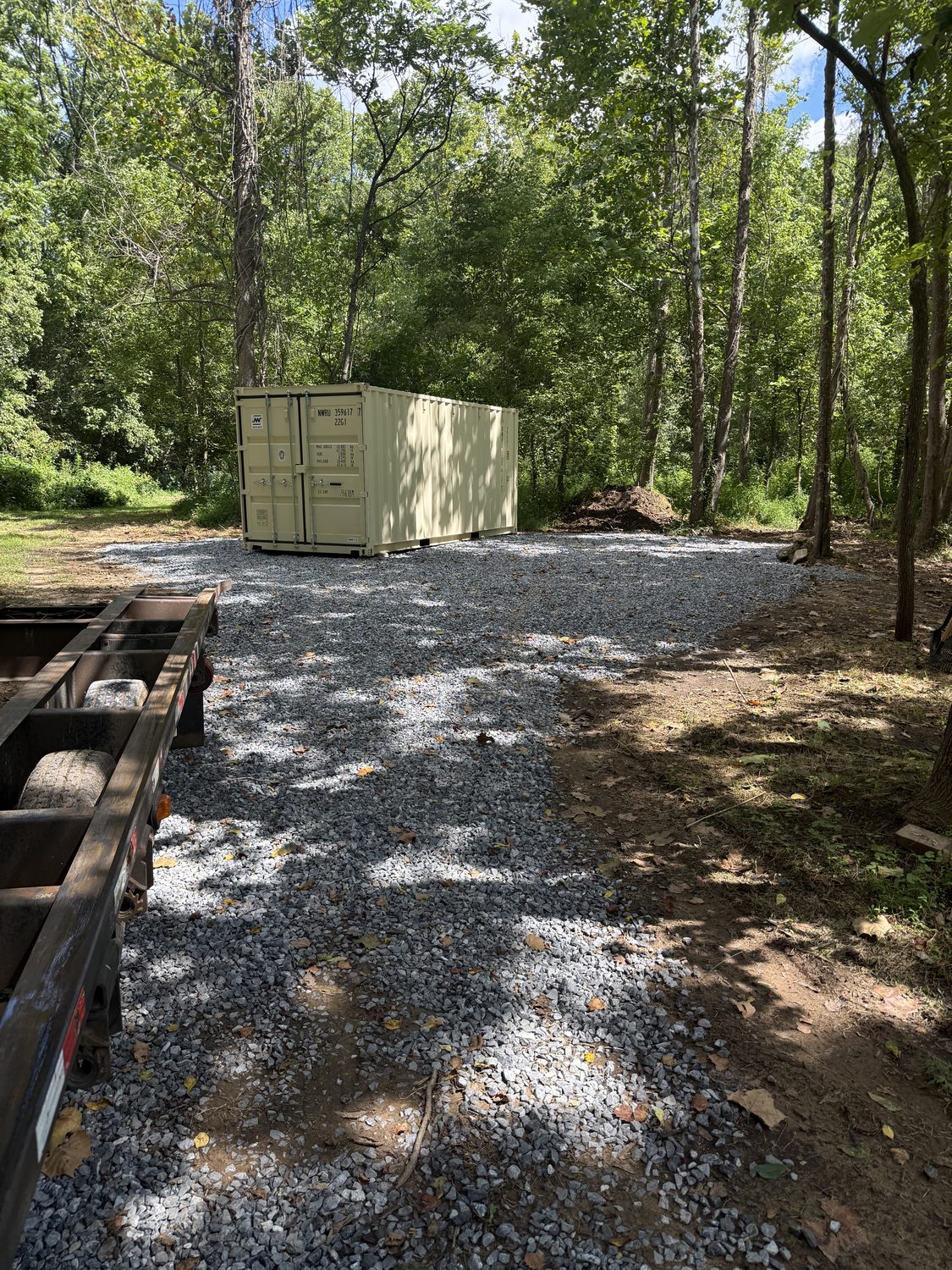
Most shipping containers don't need a poured foundation. A container carries its weight through its four corner posts, so for storage use, firm, level, well-drained ground, or better, a compacted gravel pad, is all the site work it asks for, usually with blocks under the corners to keep steel off the dirt. Concrete earns its cost only when the box stops being movable: a converted workshop, an office, anything permanent.
That's the answer in one breath. The rest of this guide walks the four foundation options in order of cost, explains when each is the right call, and finishes with the part we handle ourselves, placing and leveling the container when the truck arrives. Get the ground right and a container sits square, drains dry, and opens easy for decades.
Option 1: bare, firm ground
Plenty of containers around here sit directly on the ground, and for the right site that's fine: high ground, compacted soil, good natural drainage, and a box that's there for storage rather than forever. If the spot stays dry after a hard rain and doesn't give underfoot, a container can sit on it happily, especially a short-term rental.
Bare ground fails in predictable ways, though. Low spots collect water. Clay holds it. Soil that feels fine in August turns to sponge in March. When a corner settles, the frame racks and the doors stop swinging true, the number one long-term complaint with ground-set boxes. Soft, muddy ground is also the number one cause of a delivery that has to be rescheduled, because a loaded truck can sink or get stuck before the box ever comes off. If the spot is still spongy when you walk it after rain, it isn't ready.
Option 2: the gravel pad
For most buyers, this is the sweet spot. A crusher-run gravel pad a little larger than the container's footprint, compacted and crowned so water sheds off the middle, gives you most of what a slab does for a fraction of the money: a firm, level base that drains instead of pooling. Gravel drains well and keeps the corners from settling, and a local grader can typically build a pad in a day.
Size it slightly bigger than the box so the corners never bear right at the pad's edge, a 20-ft container covers about 160 square feet and a 40-ft about 320, so even the big pad is a modest job. And the crown matters more than the thickness: the goal is rain running away from the steel, not under it.
One more point in gravel's favor: it's reversible. If the container moves on in five years, you're left with a clean, useful parking pad instead of a slab to break up, worth remembering whenever the box might be a chapter rather than the whole story.
Option 3: blocks under the corners
Solid concrete blocks set under the corner castings are the cheapest upgrade with the biggest payoff, on bare ground or on a pad. They lift the steel off damp ground so air moves underneath, they carry the load at the four points the container is engineered to bear on, and they make re-leveling trivial, if a corner ever settles, you lift, shim, and you're square again in minutes.
The word solid matters, by the way: use solid concrete blocks, not hollow-web wall block. All of the container's weight lands on four small faces, and solid block carries that concentration without cracking. It's a small difference at the supply store and a big one two winters in.
This is also simply how we deliver: our crew sets the container on blocks and levels it as part of every drop, because a level box is what keeps the doors sealing for the next 25 to 30 years. Blocks on a crowned gravel pad is the setup we'd put under our own containers.
Option 4: full slab or concrete piers
Once a container becomes a building, the foundation graduates with it. A full slab gives a workshop a finished apron, takes point loads anywhere on the floor, and won't shift under years of daily use. Concrete piers under the corners deliver the same permanent support with far less concrete. Either is the right call for a container workshop, an office, or any build-out you never intend to move.
One honest warning: a foundation can change the permitting picture. Anchor a container to a slab or piers and it usually stops being a movable accessory structure and gets pulled into the building code, and permanent installs may need tie-downs to resist wind. Read our permit guide before you pour, and make the call to your county while the concrete is still an idea.
Drainage: the real enemy
Whatever the container sits on, water pooling underneath is what actually shortens its life. A box over wet ground rusts its crossmembers from below, wicks humidity up through the floor, and feeds the condensation cycle inside, the "container rain" that soaks stored goods. Our condensation guide covers the inside half; the outside half is just keeping water on the move:
- Crown the pad so rain sheds off the middle instead of settling under the frame.
- Cut a shallow swale on the uphill side if the site slopes toward the container.
- Extend downspouts past the box when it sits close to a house, shop, or barn.
- Skip the low corner of the property. If nothing else will park or grow there, that's the water telling you something.
What our crew does on delivery day
Within 75 miles of Woodlawn, delivery and leveling are free, and leveling is the step that makes every option above actually work. Our tilt-bed trailer slides the container off as the truck pulls forward, which needs a straight run of roughly 65 feet for a 20-ft box and about 95 feet for a 40-ft. The crew sets the container on blocks, checks it level, and makes sure the doors swing true before leaving. A small slope we handle on blocks; a steep grade may need grading first.
The best thing you can do ahead of time is send photos of the spot, the approach, the pad, anything that looks tight, so we can confirm fit before the truck rolls. Our delivery preparation guide has the full site checklist. Then call (276) 237-6144 or request a quote, and we'll tell you honestly what your ground needs, which, most of the time, is less than you think.