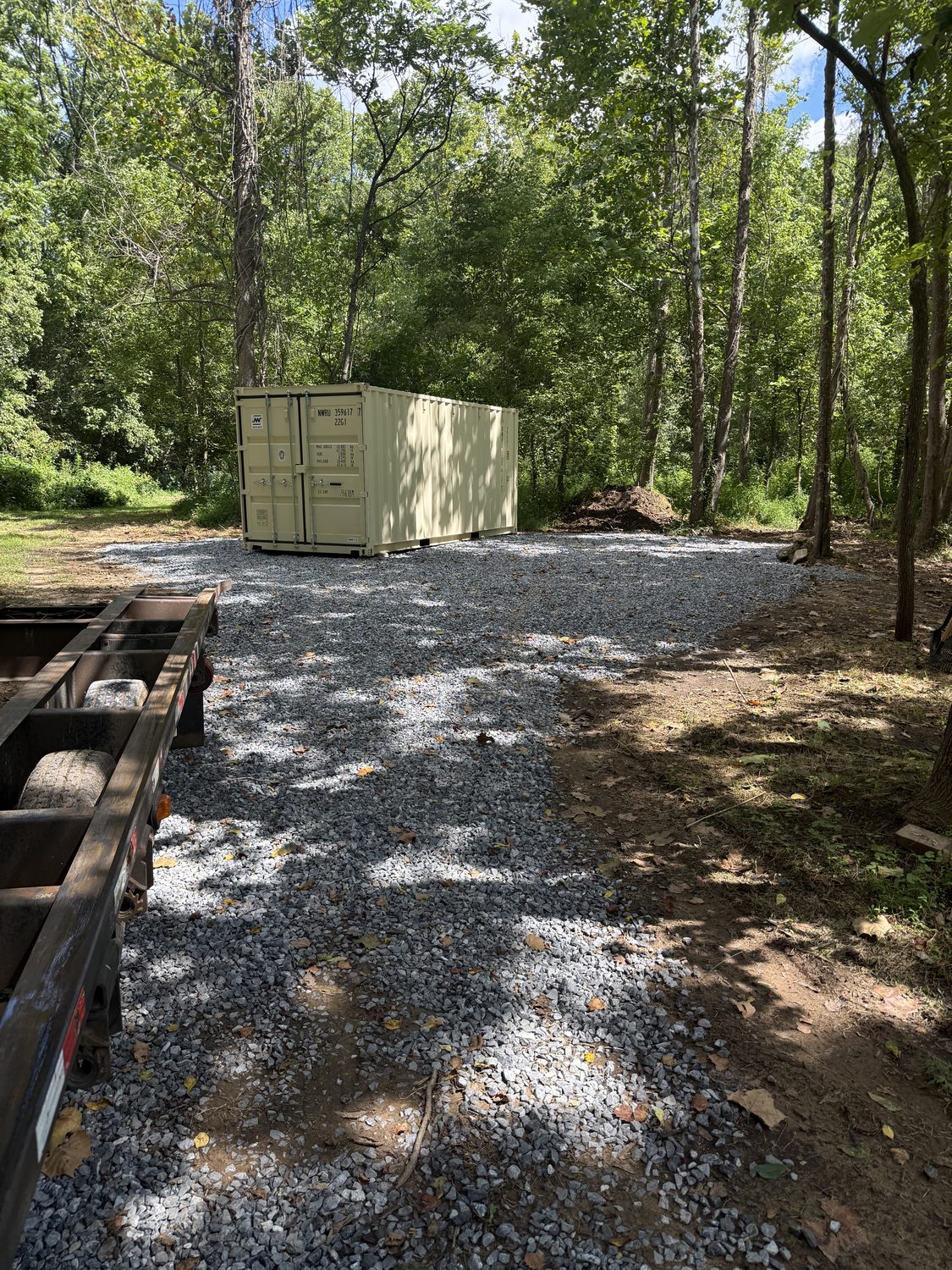
Most counties we deliver into are quiet about shipping containers. Pulaski County is not. Its zoning ordinance says the words storage containers out loud, inside a definition, and what it says is restrictive: one may not be used to store things for more than 30 days in any of five residential districts. That is adopted law in force right now.
This is also where the two halves of the permit question come apart most visibly. Virginia's statewide building code leaves a storage box alone. The county ordinance does not. Both are true at once, and the reader who only knows the first one is the reader who gets a letter.
So this page leads with the ordinance's own sentence, is careful about what that sentence does not cover, separates the county from the two towns inside it, and ends with numbers we pulled from the governments' own pages.
Pulaski County has been zoned since 1990
Get this straight first, because people arrive with the wrong assumption from next door. Our own Carroll County has no adopted countywide zoning, and Wythe County is drafting its first ordinance. Pulaski County is the opposite, and its ordinance says so in its own history section: Pulaski County adopted zoning for the entire County in November 1990.
What governs today is a Unified Development Ordinance, adopted October 26, 2015 and amended repeatedly since, most recently on July 27, 2025. It incorporates an Official Zoning Map, kept in the county's mapping system and on file with the Clerk of Circuit Court, and it is backed by a Planning Commission and a Board of Zoning Appeals. This is a county with a full front counter.
The one sentence that settles most residential placements
The rule is not in a chapter about outdoor storage. It sits inside the ordinance definition of Accessory Building or Structure, which is where nobody thinks to look. Word for word:
Two things happen there at once. Containers get pulled out of the accessory-structure category, so the ordinary shed and garage provisions are not the provisions that apply to them. And using one for storage past 30 days is prohibited outright in five named districts:
- RR, Rural Residential
- R, Residential
- LR, Low Density Residential
- MR, Medium Density Residential
- HR, High Density Residential
Rural Residential is the one that catches people. A few acres with a treeline, a barn and a gravel drive reads as farmland from the road and can still be mapped RR, which is on the list. Looking rural is not the same as being zoned agricultural, and only the county's map settles which one you are.
We would rather lose a sale here than put a box on somebody's ground that they have to move in a month.
Silence in the other districts is not permission
It would be convenient to read that sentence backwards and announce that containers are welcome in the Agricultural, Commercial and Industrial districts. We are not going to, and be careful of anyone who does.
The ordinance tells you what a container is not, and where it may not be used. It never tells you what a container is. There is no container entry in the land use table, no container use category, and no container screening standard anywhere in the document.
The permit trigger has the same gap in it. A zoning permit is required for construction of an accessory structure on a residential property, and the definitions have already said a container is not an accessory structure, so that clause does not clearly reach one. What is left is the catch-all, which requires a permit any other time when the UDO Administrator determines a Zoning Permit is required. Outside the five residential districts, whether a container is allowed and whether it needs a permit are both that administrator's call.
The building code and the zoning ordinance answer different questions
The building code, which is statewide
Virginia's building code names a set of things it does not reach, and containers sit on that list. 13VAC5-63-20 section 102.3, Exemptions, item 11 covers intermodal freight, moving and storage containers placed on site temporarily or permanently for use as a storage container. The companion 13VAC5-91-20(E) exempts the same containers from the Industrialized Building Safety Regulations when used for storage.
Pulaski County's Building Office administers the USBC locally and adopted the 2021 Virginia Construction Code and Virginia Residential Code as of January 18, 2024. Nothing it publishes carves a local exception out of that exemption. The exemption follows the use, not the steel and not the calendar, so occupancy is what ends it. Our Virginia permit guide walks that line in the regulation's own words.
The zoning ordinance, which is local
None of the above touches zoning. Not a word of it. You can sit squarely inside the state exemption and still be in violation of the county ordinance, which is exactly what happens in those five districts. Both offices share an address and a phone number, so ask them both in one call.
One thing we do not do, here or anywhere: we do not pull permits and we do not file zoning applications. On modifications, our electrical is roughed in only, with a licensed electrician doing the final hookup and the inspection.
The Town of Pulaski and the Town of Dublin sit outside the county ordinance
The ordinance is unusually clear about its own edges and states them twice. It applies to all property within the Town of Draper, VA and unincorporated portions of Pulaski County, Virginia, and elsewhere it says the incorporated areas are the Town of Pulaski and the Town of Dublin, that these two towns are not regulated by this Ordinance, and that permits are obtained from each respective town.
So a parcel inside either town does not answer to the 30-day rule quoted above. It answers to that town's own ordinance, and we could not verify what either town says about containers. Ask the town rather than assuming either way. Building permits split differently:
| Where the parcel actually sits | Zoning desk | Building permit desk |
|---|---|---|
| Anywhere the county UDO applies, including Draper | Pulaski County Planning and Zoning, 540-980-7710 | Pulaski County Building Office, 540-980-7710 |
| Inside Town of Dublin limits | Town of Dublin Planning and Zoning, 101 Dublin Park Rd | Pulaski County Building Office, 540-980-7710, since May 1, 2025 |
| Inside Town of Pulaski limits | Town of Pulaski Planning and Zoning, 42 1st Street NW, 540-994-8615 | The town publishes its own Certified Building Official, so confirm routing with the town |
Draper is named in the county ordinance as territory the ordinance covers, so the county UDO applies there.
Now the trap. Two governments here are called Pulaski, and both sit in the town of Pulaski a few blocks apart. Pulaski County Community Development is at 143 Third Street NW, Suite 1, at 540-980-7710. The Town of Pulaski Planning and Zoning is at 42 1st Street NW, at 540-994-8615. Different street, different phone, different ordinance. Call the wrong one and you get a confident answer about somebody else's rules.
And confirm which side of the line you are on before dialing. A mailing address that reads Dublin or Pulaski does not by itself put the parcel inside town limits, and plenty of them are not.
The New River, Claytor Lake, and the floodplain office
The county's floodplain ordinance lives in the same UDO but is administered by the Engineering office, not Planning and Zoning. Engineering handles floodplain permits, land disturbing permits and erosion and sediment control, and publishes its own floodplain development permit application.
The language there is broad: all uses, activities, and development occurring within any floodplain district may be undertaken only upon issuance of a permit. That is a local permit, not a building permit, so the state storage exemption does nothing for you. An unelevated accessory structure in the Special Flood Hazard Area also has to meet a list a delivered container mostly does not:
- No human habitation, and use limited to parking or limited storage
- No more than 600 square feet of total floor area
- Flood damage resistant materials below the base flood elevation
- Anchored to prevent flotation
- Fitted with flood openings, at least two on different sides, at least one square inch per square foot of enclosed area
A steel container has no flood openings and is not anchored when it comes off the trailer. Whether either can be added acceptably is Engineering's call. Note too that the ordinance's own footnote applies those base flood elevation provisions along rivers and streams where FEMA has set elevations, and not along lakes, which matters here because the New River is a river and Claytor Lake is a lake.
Waterfront gets named specially elsewhere as well. In the lot standards for the Agricultural district, a footnote lets a parcel fronting Claytor Lake, the New River, or the stretch of Peak Creek between I-81 and Claytor Lake cut the setback to 25 feet from the property line next to the water. We read that footnote in the Agricultural table, so ask whether the same allowance rides your own district before you count on it. The county also issues dock permits and no wake buoy permits separately. We did not verify whether the lake's operator asserts any shoreline authority of its own, so we will not tell you it does or it does not. Put it on the list to ask.
Three desks, and which one your parcel belongs to
Building, Engineering, and Planning and Zoning all sit under Community Development at one address on one main line. John Crockett is the Community Development Director.
Pulaski County Planning and Zoning
Your district, the container question, setbacks, and whether a zoning permit applies. Markie Saunders is Director of Planning and Zoning, with Levi Dalton as Planning, Zoning and GIS Coordinator.
- 143 3rd St NW, Suite 1, Pulaski, VA 24301
- 540-980-7710, fax 540-980-7717
- The office does not publish hours, so call in the morning
Pulaski County Building Office
The building code side, and the office to call the moment a conversion into occupied space enters the picture. Scott Macdonald, MCP, CBO, is the Building Official. This office also issues Town of Dublin building permits.
- 143 Third Street NW, Suite 1, Pulaski, VA 24301
- 540-980-7710
- Monday to Friday, 8:00 a.m. to 5:00 p.m.
Pulaski County Engineering
Floodplain permits and land disturbing permits. W. Nelson Pendleton, Jr., P.E. is the County Engineer, with Christopher Webster running erosion and sediment control. Same address, 540-980-7710, hours not published.
The towns, if you are inside town limits
Town of Pulaski Planning and Zoning is at 42 1st Street NW, Pulaski, VA 24301, 540-994-8615, open 8:30 a.m. to 5:00 p.m. Monday through Friday, with Nathan Smythers as Certified Building Official and Zoning Administrator and Carla Hodge as Certified Zoning Official.
Town of Dublin names no zoning official on its published page, and no phone number or hours appear on any Town of Dublin page we could read. Aggregator sites list a number. We did not verify it and will not print one we cannot stand behind, so start at the town office at 101 Dublin Park Rd, Dublin, VA 24084.
Five answers that settle a Pulaski County placement
Keep your parcel number, or the 911 address if that is what you have, within reach before the call starts.
- What zoning district is this parcel in? In Pulaski County that one answer decides most of it, because RR, R, LR, MR and HR are the five where container storage past 30 days is prohibited.
- If it is not one of those five, is a storage container allowed there, and does a zoning permit apply? Containers are defined out of the accessory-structure category, so this is the UDO Administrator's call.
- Is any part of this parcel in a floodplain district? If so, ask to be transferred to Engineering.
- Is this address inside the corporate limits of the Town of Pulaski or the Town of Dublin? Neither town is under the county ordinance, and for Dublin the building permit still comes from the county.
- If the parcel fronts Claytor Lake or the New River, does anything beyond the county setback apply to placing a container near the water?
Write down who answered and the date. That note is worth more later than anything on this page. And ask whether the ordinance has changed, because this county amended it four times in the last two years and everything above reflects the July 2025 edition.
Once the district question is answered, the ground is the other half
A container arrives on a tilt-bed trailer and slides off, so the truck needs a straight approach and something firm underneath it: about 65 feet of straight pull-in for a 20-ft and about 95 feet for a 40-ft, plus room to back in before that. What we ask about before quoting a Pulaski County address:
- A clear straight run at the drop spot, not just clear at the pad
- Ground that will carry a loaded truck, gravel being the friendliest surface
- Overhead clearance the whole way in, since limbs and service drops stop more jobs than gate width does
- A spot close to level, because a container out of level fights you on the doors
Distance is not the problem here. Pulaski sits about 45 road miles from our Woodlawn yard and Dublin about 50, both inside our 75 road mile free delivery and leveling zone, so no Pulaski County quote carries a mileage line. More in our delivery preparation guide and foundation guide.
The short version, if you own Pulaski County acreage
Pulaski County is the sharpest illustration we have of why the two questions get asked separately. The state answers the building question in your favor for storage use, and then the county answers a different question and, in five residential districts, answers it no.
So do not order first. Get your district, in writing if they will give it to you, and let that steer the conversation. In RR, R, LR, MR or HR, ask the county what it would take, because storage past 30 days is not on the table as the ordinance reads. Elsewhere in the unincorporated county, ask whether a container is allowed on that parcel and whether the administrator wants a permit for it. In either town, it is a different rulebook and a different desk.
Once you know where the box can legally sit, the rest is ordinary. A used cargo-worthy 20-ft is $3,200 delivered inside our free zone and a 40-ft is around $4,900, or rent from $165 a month for a 20-ft and $235 for a 40-ft. Free delivery and leveling runs to 75 road miles, which covers the county, and every container leaves with the lockbox already welded on, so security is not something you buy on top. Call us at (276) 237-6144 once the county has answered, or read our buy versus rent guide first.