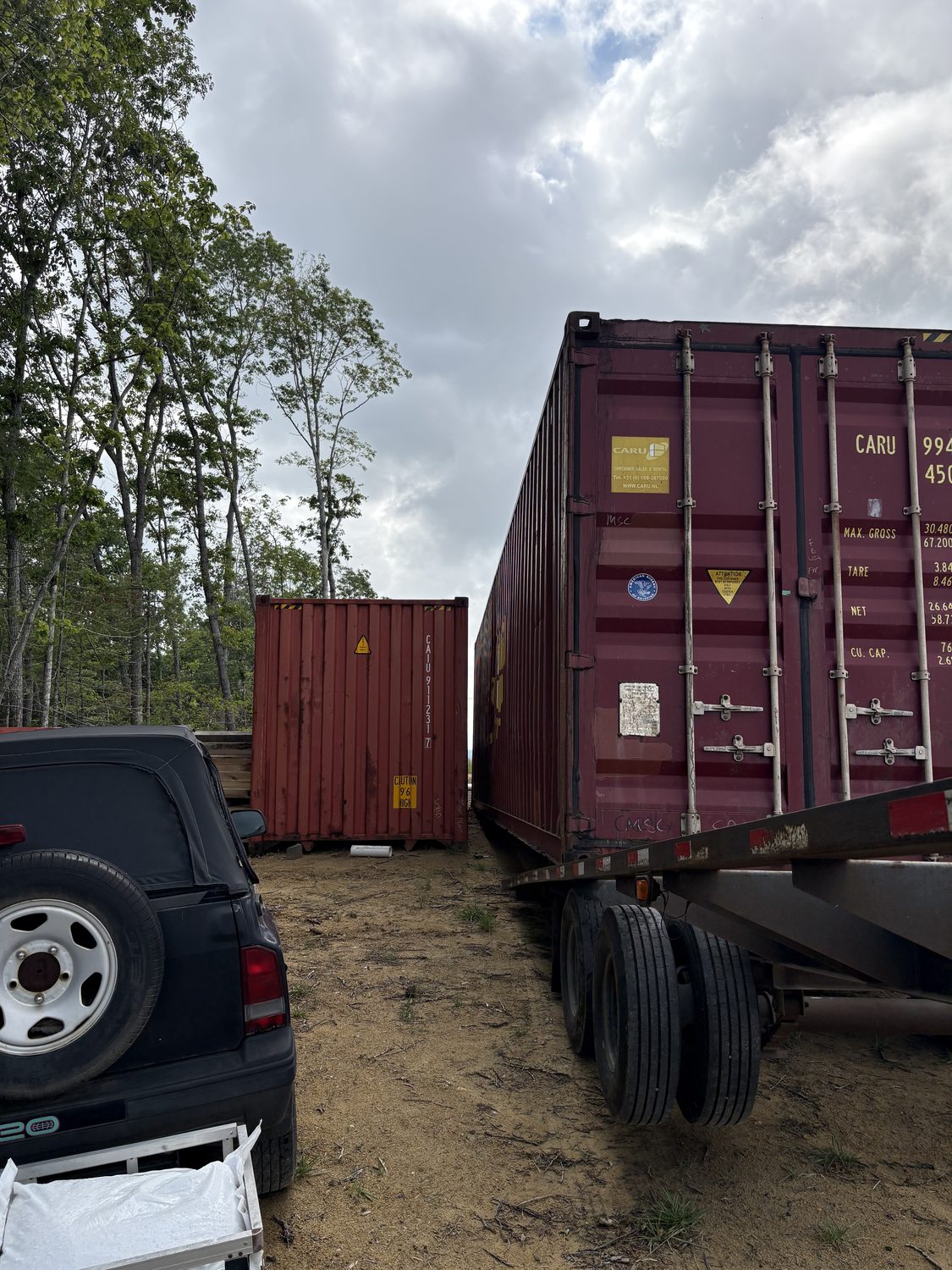
If you are setting a shipping container on property in North Carolina, the honest starting point is this: assume a building permit is required, and let your local building department be the one to tell you otherwise. That is the opposite of what most buyers expect. Almost everyone arrives at this page believing a container is treated like a backyard shed, and in North Carolina that assumption does not hold up.
The state does exempt certain small detached accessory buildings from the building permit requirement. The problem is that the exemption is written around a dimensional limit that no ISO shipping container can meet. A 20-ft box and a 40-ft box both blow past it on length before you even measure anything else. So the statewide default lands on the permit-required side of the line, unless the specific city or county where the container is going has adopted its own separate exemption or its own process for shipping containers. Some jurisdictions have. Plenty have not. The variation is exactly why a local phone call beats a confident guess every single time.
Below is the rule in plain language, why it catches containers, what triggers a separate electrical or plumbing permit, how commercial and jobsite placements usually get handled differently, and the short list of questions to ask when you call. This is a statewide overview, not legal advice, and it is not a substitute for your jurisdiction's answer.
The short version, before the citations
Most people reading a permit page want the bottom line first, so here it is. North Carolina law exempts a narrow category of small accessory buildings from the building permit requirement. Shipping containers do not fit inside that category because of their size. That does not mean a permit is impossible to get, and it does not mean your project is in trouble. It means the default answer is yes, a permit applies, and the burden is on you to confirm whether your city or county has a different rule on the books.
- The statewide accessory building exemption has a hard ceiling of 12 feet in any single dimension.
- A 20-ft container is about 20 feet long. A 40-ft container is about 40 feet long. Both fail that test on length alone.
- So no container we sell or rent qualifies for the small structure exemption, regardless of what you use it for.
- Local governments can and sometimes do adopt their own container specific exemptions, permit paths, or zoning conditions.
- Wiring, outlets, or lighting trigger an electrical permit separately. A sink, toilet, or any plumbing fixture triggers a plumbing permit separately.
- Placements on an active commercial or industrial jobsite are frequently covered by that site's existing permits, but that has to be confirmed, not assumed.
The 12 foot rule, and why a container never clears it
The relevant authority is North Carolina General Statute 160D-1110(c), applied through the NC Residential Code and reflected in guidance from the NC Office of State Fire Marshal. It carves out an exemption from the building permit requirement for a one-story detached accessory building, but only when three separate conditions are all satisfied at once.
- The structure does not exceed 12 feet in any dimension. Not 12 feet of floor area, not 12 feet average. Twelve feet in length, twelve feet in width, and twelve feet in height, each measured on its own.
- The structure is used for residential storage purposes.
- The structure is not placed on a permanent foundation.
Those conditions are cumulative. Miss any one of them and the exemption does not apply, which puts you back under the ordinary building permit requirement. And the dimensional condition is the one that ends the conversation for shipping containers before the other two ever get evaluated.
Standard ISO containers run roughly 8 feet wide and either about 8 feet 6 inches or about 9 feet 6 inches tall depending on whether it is a standard height or a high cube. Width and height are comfortably under 12 feet. Length is not. A 20-ft container is right around 20 feet on the outside, and a 40-ft container is right around 40 feet. Either one is well past the ceiling. There is no configuration, no use case, and no paperwork that shrinks a 40-ft box into a 12-foot exemption.
It is worth being clear that the state is not singling out shipping containers here. The exemption says nothing about corrugated steel, ISO corner castings, or cargo doors. It is written around size, use, and foundation, and it applies the same way to any detached accessory building. Containers fail it on the tape measure, not on the material. That framing keeps the conversation with your building department productive: you are not asking whether containers are allowed as a matter of principle, you are asking how a detached accessory structure that exceeds the exemption threshold gets permitted in that jurisdiction, and whether the local ordinance says anything about containers on top of that.
The foundation condition is worth a note as well. The exemption requires that the structure not sit on a permanent foundation. When we deliver, we level the container on blocks as part of the delivery, which is not a permanent foundation by any ordinary reading. That can be genuinely helpful in other conversations, including some zoning discussions and some assessment questions, because a blocked and leveled container is a movable object rather than a fixed improvement. It does not rescue the building permit question, though, because the dimensional test has already failed and all three conditions have to hold together.
Where local rules change the answer
The statewide default is the floor, not the ceiling. Cities and counties in North Carolina administer their own building departments and their own zoning ordinances, and they have real latitude in how containers get handled on the ground. Two properties fifteen minutes apart, across a county line or inside versus outside a town limit, can genuinely land on different answers. This is not bureaucratic noise. It is how the system is designed.
When a jurisdiction has thought about containers specifically, the local rules usually address some mix of the following.
- Whether a container is permitted at all as an accessory structure in your zoning district, and whether residential districts are treated differently from agricultural, commercial, or industrial ones.
- Setbacks from property lines, from the road right of way, and from the primary structure.
- Screening, placement behind the front building line, or restrictions on visibility from the street.
- Limits on the number of containers allowed on a single parcel.
- Paint, condition, or appearance standards, sometimes including a requirement that cargo markings be covered.
- Whether a temporary placement, for instance during construction or after storm damage, follows a shorter and simpler process than a permanent one.
- Whether an existing homeowners association or subdivision covenant independently restricts containers, which is a private agreement rather than a government rule but will still stop your project cold.
Notice that most of that list is zoning, not building code. Those are two different reviews handled by two different parts of the same office in many counties. It is entirely possible to satisfy one and fail the other, so when you call, ask about both by name rather than asking a single general question about whether containers are okay.
Electrical and plumbing permits are a separate question entirely
Whatever happens with the building permit, wiring and plumbing are their own tracks. If a container has electrical work in it, meaning outlets, lighting, a panel, a subpanel, or anything hard wired, an electrical permit is required. If it has a sink, a toilet, a water heater, a drain, or any fixture at all, a plumbing permit is required. Those requirements exist independently of whether the structure itself needed a building permit, and they do not go away because the container is technically portable.
This connects directly to how our shop works, so it is worth being blunt about the division of labor. Everything we build is done in house at the Woodlawn shop. On the electrical side, we rough in only, and a licensed electrician performs the final hookup and the inspection. We do not pull electrical permits, and we do not present ourselves as the licensed party for that portion of the work.
Practically, that means the permitting conversation for a modified container has two halves. You or your general contractor handles the building side with the county. Your licensed electrician handles the electrical permit and the inspection for the hookup. We will happily coordinate with both, tell your electrician exactly what we roughed in and where, and provide a written, itemized quote for the modification work itself so nobody is guessing about scope.
Jobsite and commercial placements often work differently
Almost everything above is written with a residential property in mind, because that is where the confusion concentrates. Commercial and industrial placements frequently follow a different and often simpler path. When a container is being used as jobsite storage on an active construction site, the container is typically treated as part of the site's temporary operations and is covered under the permits already issued for that project rather than requiring its own separate container permit.
That is a common outcome, and it is why general contractors tend to be the least anxious customers on this topic. It is still not automatic, and it still varies by jurisdiction. A few things affect how it lands.
- Whether there is an active, currently open permit on the site, as opposed to a project that has already been closed out.
- How long the container is staying, since a box that outlives the construction schedule starts to look like a permanent accessory structure to a zoning officer.
- Whether the container is purely storage or is being used as an office, break area, or anything occupied, which raises different code questions.
- Whether the site is inside a municipality with its own temporary structure rules layered on top of the county's.
- Whether the placement is in a floodplain, a watershed overlay, or another special district, which can add review regardless of use.
The rule of thumb is the same as the residential one, just with a different phone number. Confirm with the jurisdiction that the container is covered under the site permits, get the name of who told you, and move on. Do not assume it because it usually works out that way.
What to ask when you call the building department
The quality of the answer you get depends almost entirely on how you frame the question. Walking in with "can I put a shipping container on my land" invites a shrug or a cautious no. Walking in with specifics gets you a real answer, usually in one call. Have your parcel number or property address ready, know which container size you are buying or renting, and know what you plan to store or do inside it. Then work through this list.
- I am placing a detached accessory structure that exceeds 12 feet in a dimension, so I understand the state exemption does not apply. What is your process for permitting it?
- Does the zoning ordinance address shipping containers specifically, and if so, in which districts are they allowed?
- What are the setback requirements for an accessory structure of this size on my parcel?
- Are there screening, placement, or appearance conditions I need to satisfy?
- Is the process different if the container is temporary versus permanent?
- The container will be set and leveled on blocks, not on a permanent foundation. Does that change anything on your end?
- If I add wiring later, what does the electrical permit process look like and does my electrician pull that or do I?
- Roughly how long does this review take, and what do you need from me to start it?
Write down the name of the person you spoke with and the date. If they tell you no permit is needed, ask whether they can put that in an email. It costs them nothing, and a two line email from the county is worth an enormous amount if the question ever comes up again during a sale, an insurance claim, or a neighbor complaint.
There is a practical reason we push this so hard, and a practical reason to make the call before the truck is loaded rather than after. A shipping container is not something you tuck behind the garage and sort out later. It arrives on a tilt-bed trailer and gets rolled into position, and the site has to be ready for that. If a permit question turns into a relocation question after the box is already on the ground, you are paying to move a very heavy object twice. While you are sorting the permit, confirm the site works mechanically too: we need roughly 65 feet of straight, clear pull-in for a 20-ft container and roughly 95 feet for a 40-ft, overhead clearance along the whole approach, and ground firm enough to carry a loaded truck without rutting.
County guides across our North Carolina service area
Because the local answer is the one that actually governs, we are working through the counties in our North Carolina service area and building dedicated guides as we confirm the details with each jurisdiction. That work covers the northwestern part of the state we serve most often out of the Woodlawn yard, including Surry, Wilkes, Ashe, Yadkin, Stokes, and Forsyth counties, along with the municipalities inside them, which sometimes have rules of their own separate from the county's. The permits hub is where those guides land as they go live. The county guides published so far read the ordinances and name the desks for Surry County, Wilkes County, Alleghany County, Ashe County, Yadkin County and Stokes County; for a Forsyth County address, start with our Winston-Salem permits and placement page.
Until the guide for your county exists, this statewide page plus one phone call to your building department will get you a reliable answer. If you tell us where the container is going, we can at least tell you the container's real dimensions, how we set and level it, and which questions are worth asking the jurisdiction first.
On the buying side, our pricing is out the door and does not move around on you. A used cargo-worthy 20-ft delivered is $3,200, and a used cargo-worthy 40-ft delivered is around $4,900. Rentals run $165/month for a 20-ft and $235/month for a 40-ft. Delivery and leveling within 75 road miles of the Woodlawn yard are free and already built into those numbers, as is the welded lockbox, which ships standard on every container we sell and every container we rent. Past 75 miles we quote the mileage charge up front, before the truck rolls, so it is never a surprise on the invoice. What is not included in any of that is permit fees, which are set by your jurisdiction and paid to them directly.