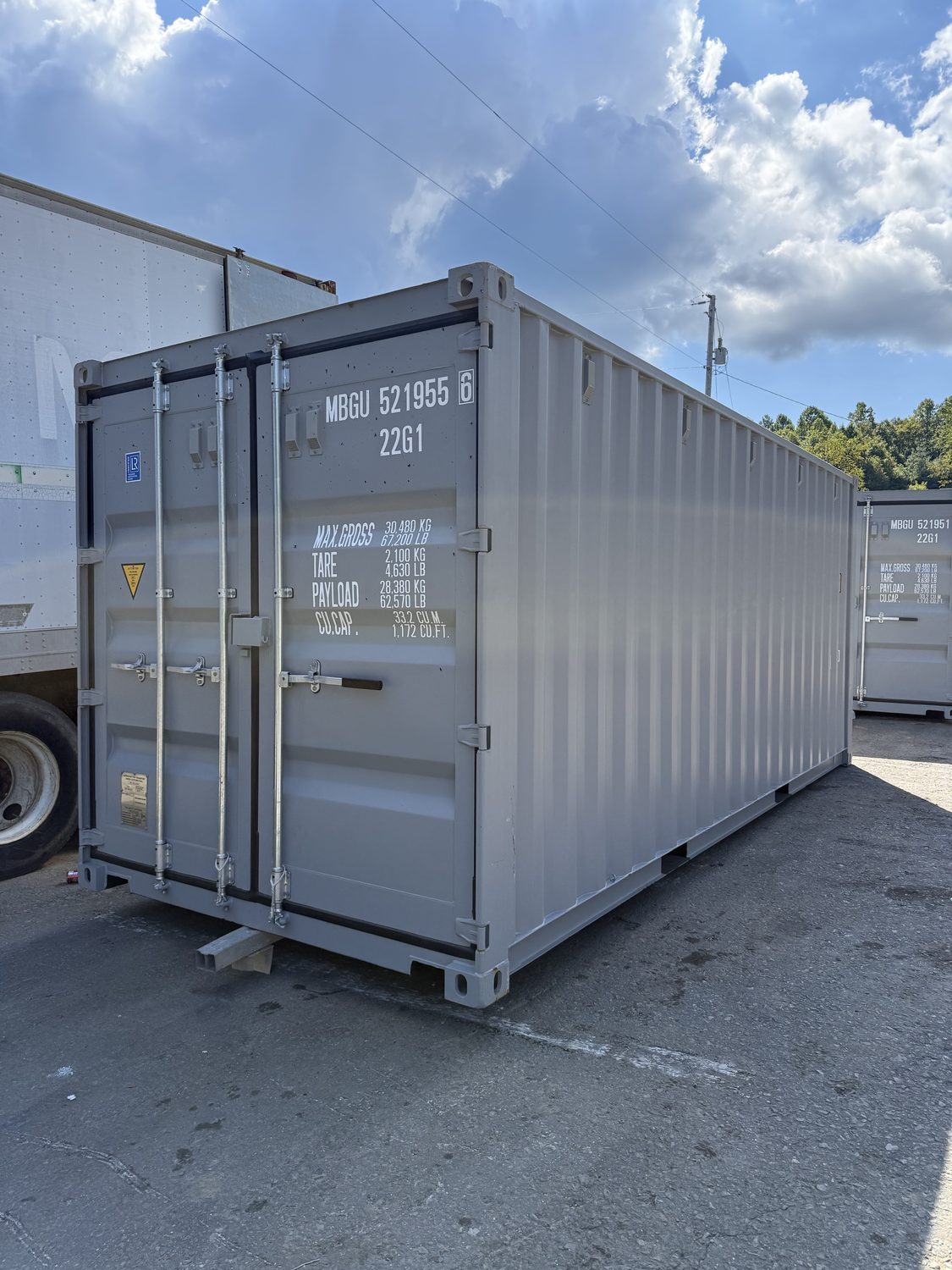
At about 56 road miles down US-52 from the Woodlawn yard, Winston-Salem is well inside our free delivery zone. What takes more thought than the drive is whether the spot you picked needs paperwork before the truck loads.
We run 20-ft and 40-ft containers down into Forsyth County regularly, and the drive is settled business. What is not settled until somebody asks is whether the placement you have pictured needs approval from the city or the county first, and whether the ground in that corner of the property will carry a loaded truck after a wet week.
This page takes both halves for a Winston-Salem address. The legal half belongs to your jurisdiction. The physical half is ours to talk through with you. We do not apply for permits and this is not legal advice, but we can tell you where North Carolina starts from, why a city of this size behaves differently than the rural counties around our yard, and what the truck and the box need from your lot.
The exemption most people have in mind covers small detached accessory buildings used for residential storage. It is real, and it is genuinely useful for a garden shed. It lives in General Statute 160D-1110(c) and turns on three conditions that all have to hold at the same time. One of them is a hard ceiling on size.
That leaves the same starting point in Winston-Salem as anywhere else in the state: treat a building permit as required until the office covering your address tells you it is not. Our North Carolina permit guide works through the statute, the separate electrical and plumbing tracks, and the questions worth having in front of you on the call. This page is the local layer on top of it.
Most of the ground we cover is rural. Carroll County, where the yard sits, has no adopted countywide zoning, and neither does Wythe County, where our sales lot is. Out there the building code is nearly the whole conversation, because there is no local zoning layer underneath it. Winston-Salem is a different situation.
Cities this size normally administer their own zoning and their own building review, keep people assigned to both, and respond to complaints. So two answers matter for your address rather than one: whether a container is allowed where you want it under the zoning rules, and what the building side needs from you. The odds of a placement going unnoticed are also lower here than on a back road in the county.
None of that is a reason to expect a no. It is a reason to ask early, while the spot is still easy to move on paper rather than with a truck. We have not published department names, phone numbers or ordinance sections for this jurisdiction and we will not guess at them, so pull the current contact off the City of Winston-Salem or Forsyth County official website and ask directly. Confirm first whether the land sits inside the city limits or out in unincorporated Forsyth County, because that decides who you should be calling at all. Up US-52, the same call goes to a different office, and our Mount Airy permits page covers the Surry County side of it.
Zoning cares about where the box sits relative to the lines on your plat, so the review and the tape measure are the same exercise. Ask for the numbers when you call, then walk the property before you commit to a corner. Relocating a container afterward is another truck, not a wheelbarrow.
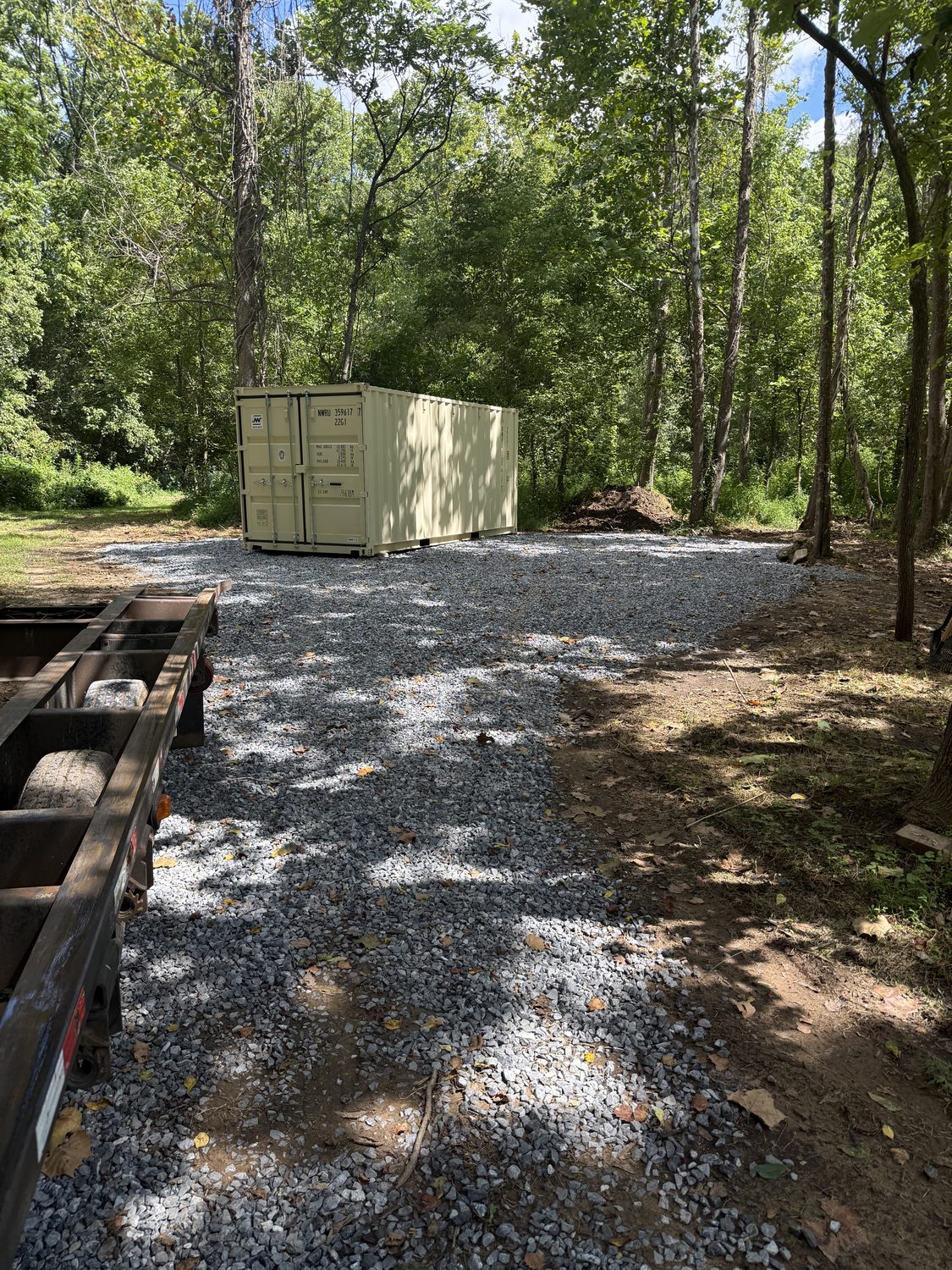
Access is its own constraint, since the container rides in on a tilt-bed and slides off the back rather than being craned into a tight pocket. A 20-ft needs roughly 65 feet of straight approach and a 40-ft needs roughly 95, which is where in-town lots bite. The Winston-Salem delivery page covers access and clearance properly.
Our part on the day is setting and leveling. The box goes down on blocks and gets leveled there, standard on every delivery rather than a line item, and the welded lockbox is on the doors before the truck leaves the yard. Blocks are not a permanent foundation, which is worth saying out loud when you describe the placement, though on its own it does not change the permit answer.
A box that lands on a commercial or industrial jobsite while the project is still running is frequently covered by the paperwork already issued for that work rather than reviewed as a structure of its own. That is common enough that contractors worry about it far less than homeowners do. It is still not automatic, and the answer can move once that project permit is closed, once the box outlasts the crew, or once anyone starts working inside it rather than storing things in it.
On a residential lot or a small farm the container is looked at as an accessory structure, which is where zoning has the most to say. Tell whoever answers the phone which of the two you have, the size of the box, and what is going inside it. Those three details are usually the difference between one call and three.
One more thing that catches people in a city: a neighborhood covenant is a private contract among owners, not something the city administers, so a clean answer from the jurisdiction does not settle it. If your lot is under covenants, read them before you pick a spot.
Send us the address, the size you are after, and roughly where the box would sit. Anything on the steel, the trailer or the set is ours to answer, and you can have it today. The paperwork side belongs to whichever office governs your parcel, and finding that out early costs one phone call.
Same-day reply. We'll send a real number, a real delivery window, and any photos we need to confirm fit.
You'll hear back from us today (or first thing tomorrow if it's late). For anything urgent, call (276) 237-6144.