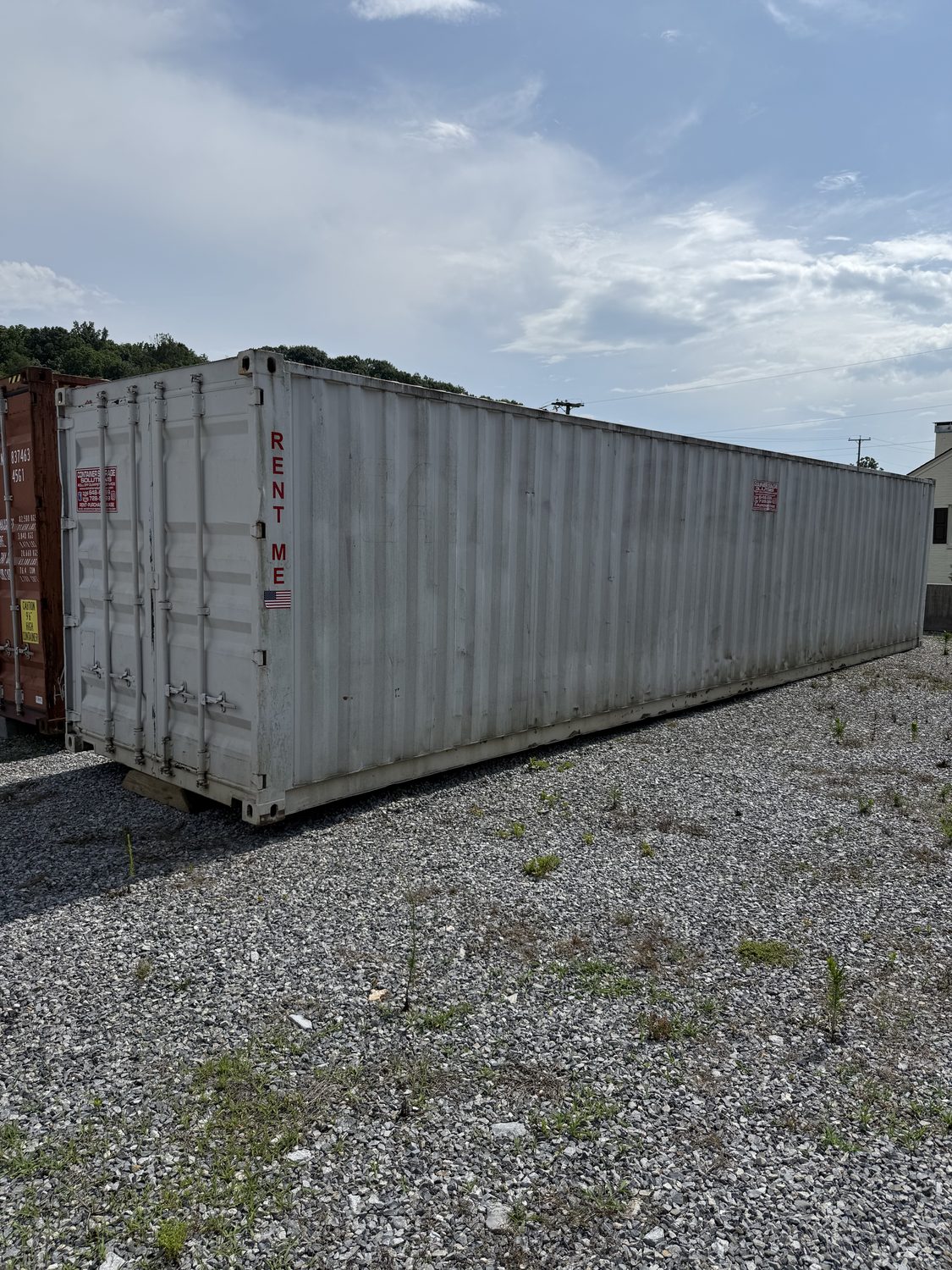
For most homeowners and small farms, the honest answer is the 20-ft container: about 160 square feet of dry, lockable steel, roughly the footprint of a small one-car garage, that still swallows the contents of a two-bedroom home. Step up to the 40-ft when you're storing vehicles, equipment, or serious inventory: at about 320 square feet, it's the cheapest space per square foot we sell.
The decision usually comes down to three things: what you're actually storing, how much room your site gives the delivery truck, and the math. Below we'll put the two sizes side by side, cover what realistically fits in each, flag the site details that quietly make the choice for you, and finish with a checklist you can run in five minutes.
The two sizes, side by side
Both sizes are the same genuine ISO box, 14-gauge Cor-Ten weathering steel over a marine-plywood floor, double cargo doors on one end, and a roughly 30-year outdoor lifespan. Width and height are identical at 8 feet wide and 8′6″ tall; the only dimension that changes is length.
- 20-ft container: 20′ long × 8′ wide × 8′6″ high, about 160 sq ft of floor and roughly 1,170 cubic feet of volume.
- 40-ft container: 40′ long × 8′ wide × 8′6″ high, about 320 sq ft of floor and roughly 2,390 cubic feet of volume.
On paper the 40 is simply two 20s laid end to end. In practice, that one continuous floor changes what you can store: long lumber lies flat, a vehicle rolls straight in, and shelving runs the full length without a wall interrupting it halfway.
What fits in each
The 20-ft is the size we deliver most, and it earns it. Inside one, our customers comfortably fit the contents of a two-bedroom home during a move or renovation, a full set of contractor tools and materials on a job site, mowers and ATVs out of the weather, or a season of feed, hay, and fencing on the farm.
The 40-ft is for the big haul. Think the contents of a 3 to 4 bedroom home, a car plus a workbench and shelving, a boat or an ATV fleet, upwards of 20 standard pallets of inventory, or long materials laid flat down that 40-foot floor. If you caught yourself nodding at anything in this paragraph, you're probably a 40-ft buyer, a 20 fills up faster than people expect.
Will the truck fit? Site realities
Here's the part that decides the question for a lot of properties before the math gets a vote. Containers arrive on a tilt-bed truck that raises the bed and slides the box off as it pulls forward, so the driver needs a straight, clear run ahead of the drop spot, not just a parking space the size of the container.
- ~65 feet of straight pull-in for a 20-ft container, a standard driveway usually works.
- ~95 feet of straight pull-in for a 40-ft, noticeably more room, and the most common reason a site takes a 20 but not a 40.
- 10 to 12 feet of width for the truck and trailer, plus clear sky overhead, no power lines, low branches, or eaves along the route.
- Firm, level ground. No concrete pad needed, we level the container on foundation blocks, but soft, muddy ground is the number one cause of a rescheduled delivery.
Walk your route before you order, and read our delivery preparation guide for the full checklist. Better yet, send us photos of the driveway and drop spot, we'll confirm which sizes fit before you commit to either.
When the high-cube matters
Standard containers stand 8′6″ on the outside. The 40-ft high-cube stands 9′6″, the same length and width, one extra foot of height. That buys you roughly 9 feet of clear headroom inside and about 2,690 cubic feet of volume, versus roughly 2,390 in a standard 40.
The extra foot earns its keep whenever you stack or build. Double-stacked tall pallets, machinery that won't clear 8 feet, and any container you plan to insulate and finish, a workshop conversion, for instance, all feel the difference, because a finished ceiling eats height fast. Delivery works the same as a standard 40-ft (same footprint, same ~95-ft pull-in), but remember the box rides and sits a foot taller, so double-check branches and wires overhead.
What the sizes cost
A used cargo-worthy 20-ft starts at $3,200 and a used 40-ft starts around $4,900, both delivered and leveled free within 75 miles of Woodlawn with a welded lockbox included. Notice what that pair of numbers means: the 40 gives you double the space for nowhere near double the price, which is why it wins on cost per square foot every time.
The same logic settles the one-40-or-two-20s question. A single 40-ft costs less than two 20-ft units and gives you one continuous floor instead of two short ones split by a wall. Two 20s only make sense when you need storage in two separate places, or your site can't take the longer pull-in. For the full picture of what moves container prices, grade, height, distance, modifications, see our 2026 price guide.
The five-minute decision checklist
Run these six questions and the answer usually falls out on its own:
- Walk your pull-in and be honest. About 65 feet of straight run for a 20-ft, about 95 for a 40-ft. No room for a 40? Decision made.
- List what's going inside. If it would fit in a two-bedroom home, a 20-ft will hold it.
- Storing a vehicle, long materials, or 20+ pallets? That's 40-ft territory, you want the continuous floor.
- Planning to insulate or build it out? Look at the high-cube for the headroom you'll lose to the finish work.
- Torn between one 40 and two 20s? One 40 is cheaper and more usable unless you truly need two locations.
- Still on the fence? Send us photos of the spot and tell us what's going in it, we'll size it with you honestly, even if the answer is the cheaper box.
That last step is a real offer, not a sales line. Call (276) 237-6144 Monday through Friday, 8 a.m. to 5 p.m. ET, and we'll talk through your site and your stuff before you spend a dollar.