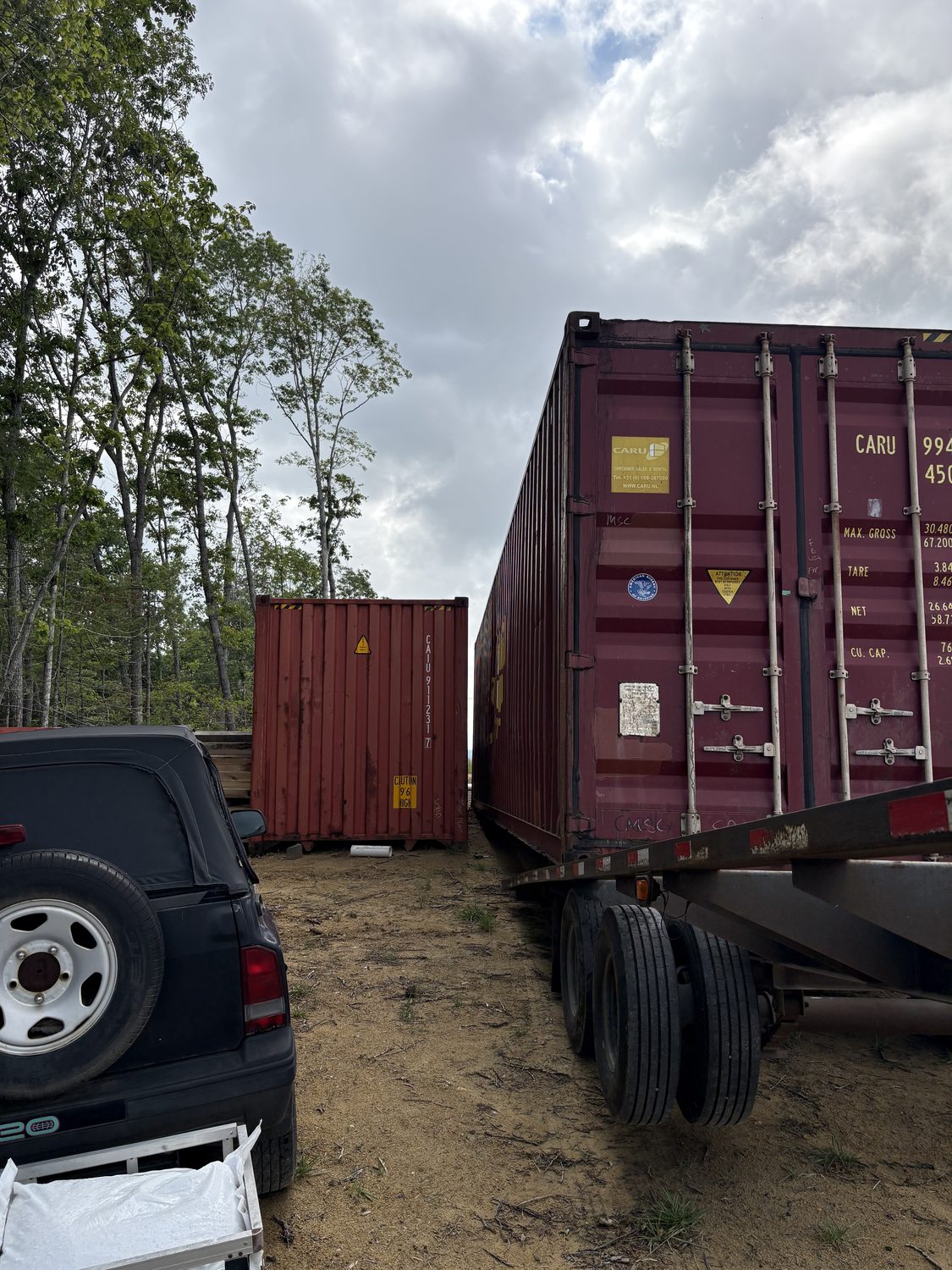
Renting month to month with no contract means you can change your mind, and people do. The job grows. The renovation uncovers more than expected. Two months turns into eight. Somewhere in there a lot of people work out that the 20 ft they rented should have been a 40.
You can absolutely make that change, and we will help you make it. But a swap is not a phone call and a different box appearing. It is a pickup, a delivery, and everything you already stacked inside moving from one container to another, and that middle part is the one nobody pictures. This page is about how swaps actually work, and about sizing the first one so you do not need a second.
Three jobs, not one
Our long term rental page puts it in a single sentence: swapping a 20 for a 40 later means a pickup, a delivery and moving everything you already stacked inside. That is the whole thing, and it is worth taking each part seriously.
The pickup
The container you have goes back on a truck as it sits, which means it has to be empty first. A container that is not empty cannot be picked up, because anything left inside goes to the yard with it.
The delivery
The replacement arrives and is set and leveled the same way the first one was, with the same requirements for access, ground and clearance.
The part in the middle
Between those two is the job people underestimate. Everything that was in the first container has to be somewhere while the swap happens, and then go into the second one. If both containers can be on site briefly, that is a straight transfer. If they cannot, your contents need a temporary home, and that is either a lot of handling or a tarp and a hopeful weather forecast.
The cheapest swap is the one you never make
Since the expensive part of a swap is handling rather than hauling, almost all of the value here is in getting the size right at the start. A few things reliably predict who ends up calling for a bigger box.
- Renovations run long and wide. The rule of thumb people get wrong is assuming they will store what they planned to store. Renovations turn up furniture, fixtures and boxes that were never on the list.
- Aisle space is not optional. A container packed wall to wall holds more and gives you access to almost none of it. If you need to get at things during the rental, you need a walkway, and that walkway is roughly a third of the floor.
- Long items set the size, not volume. Anything that will not fit diagonally in a 20 decides the question on its own regardless of how much stuff you have.
- Two months has a way of becoming six. Longer rentals accumulate. The box that was right in week one is often not right in month four.
Our 20 ft versus 40 ft guide walks through the footprints properly, and it is worth ten minutes before you book rather than after. The difference in monthly rate between the two sizes is real but modest against the cost of moving everything twice: a 20 ft rents from $165 a month and a 40 ft from $235 a month, month to month, with no contract on either.
Sometimes adding beats swapping
This is the option people forget, and on an active site it is frequently the better answer.
If the problem is that you have run out of room rather than that you have the wrong container, a second box added alongside costs you one delivery and no unloading at all. Nothing that is already stored has to move. You keep what you have, you gain what you need, and when the job ends both go back.
It also gives you something a single larger container cannot: separation. Tools in one, materials in the other. Clean in one, dirty in the other. Crew access to one and locked in the other, keyed differently. On jobsites that is often worth more than the extra floor area.
- Adding. One delivery, nothing moves, both go back when you are done. Best when you simply need more room.
- Swapping. A pickup, a delivery and a full transfer. Best when the container itself is wrong, most often when you need the length rather than the volume.
- Neither. Sometimes the answer is that the rental has outlived its purpose. Past about 18 to 20 months of renting, buying usually comes out ahead.
If you have been renting a while and are eyeing a swap, that last line is worth a conversation. If you would rather own it, in many cases we can credit a portion of what you have already paid toward the purchase price. Tell us and we will do the arithmetic with you rather than quietly renting you a bigger box for another year.
Access matters on the way out too
Everything the truck needed on delivery day it needs again, and this is where swaps and pickups most often go wrong.
Our delivery preparation guide covers the requirements in full, so the short version here: roughly 65 feet of straight clear run for a 20 ft container and about 95 feet for a 40 ft, overhead clearance the whole way, ground firm enough for a loaded truck, and vehicles moved out of the way.
The reason it catches people on the way out is that sites change while a container sits on them. Eighteen months is long enough for a fence to go up, a deck to get built, a trailer to become permanently parked, or a tree to grow into the approach. All of that was fine while the container was stationary and none of it is fine when a truck needs to back in.
- Walk the approach before you book the pickup, and look at it the way a driver would.
- Empty the container completely. It goes back as it sits.
- Check the ground. Spring thaw and saturated ground stop a pickup exactly as they stop a delivery.
- On a swap, tell us if both containers can be on site at once. It changes how we schedule and it saves you handling everything twice.
When you are simply done
If there is no swap involved and the job is finished, this is the simplest part of the whole arrangement.
Call (276) 237-6144 and we set a pickup date. Inside the 75 mile ring the pickup is free, the same as the delivery was. Empty the container, give the truck the room it had on the way in, and you are done. There is no term to run out and nothing renews on its own.
Want it for another few months instead? Same number, opposite request, no paperwork. And if you reach the end of the job and would rather not give it back, say so, because that happens more than you would think.
Our short term rental page covers the ending in more detail, and the rental agreement guide covers what you are actually signing. Between them there should be nothing about the end of a rental that comes as a surprise.