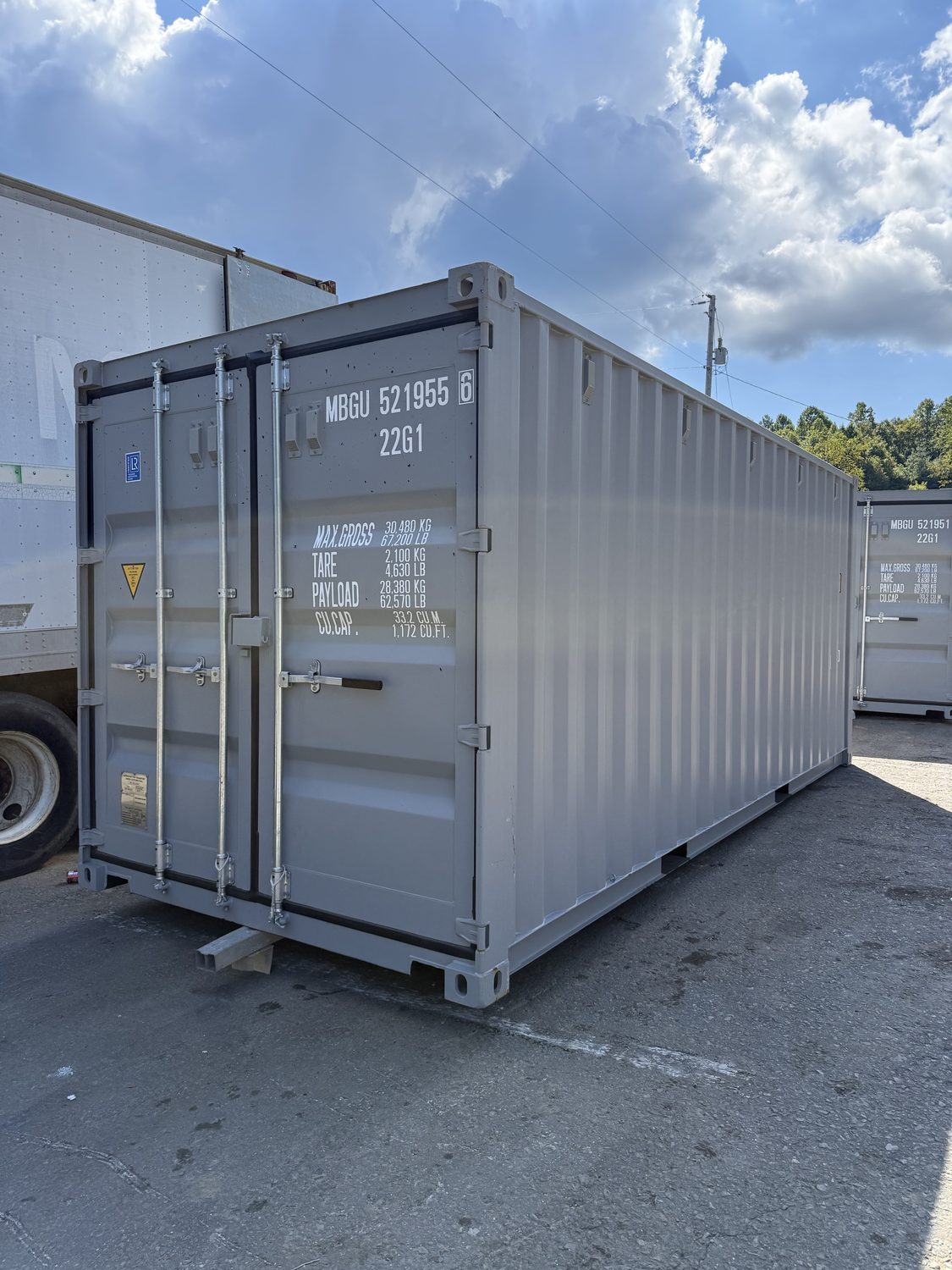
A conex box is a shipping container. If you've been pricing 20-ft and 40-ft steel boxes and the word conex keeps turning up, you're looking at the same product under an older name, and nobody standing in a container yard is going to correct you for saying it.
The vocabulary piles up fast: conex, connex, sea can, C-can, cargo container, ISO container, storage container. One came out of the US military, one out of Canada, one is an actual engineering standard, and one is a misspelling that took root. Here's where each name came from, what a genuine ISO container has that a look-alike steel shed doesn't, and why the noun on a listing matters far less than the condition of the steel in front of you.
Where the word conex actually comes from
Conex is a contraction of container express. It was US military shorthand, and it described a specific piece of Army equipment: a reusable steel box, built to a set size, that could be packed at a depot, moved by truck, rail and ship, dropped in a field and packed again. Before that, unit supplies moved as loose crates and pallets, and every transfer was handled piece by piece.
Two things about the real CONEX system are worth knowing. First, it came well before the containers you see on the road now, and it was a different animal: the original boxes were smaller, they were built for military logistics rather than commercial freight, and they weren't part of the worldwide standard that came later. Second, they went everywhere the Army went, in enormous numbers, through Korea and Vietnam, and a generation of soldiers came home still calling any steel box a conex.
So a purist has a fair point. A modern 20-ft or 40-ft container isn't literally a CONEX. It's a descendant. The military proved the idea, the shipping world standardized it at a far bigger scale, and the word outlived the equipment it described. People still say Sawzall no matter whose name is on the case.
None of that helps you buy anything. Call a yard and ask about a conex box and you'll get quoted on an ISO shipping container, because that's what everybody means by it.
Connex, sea can, and the other names you'll hear
Connex, with two Ns, is the most common misspelling. It shows up in listings, texts and paid ads, probably because the word sounds like connect. Same box. It isn't a sign of a bad seller. It's a spelling.
Sea can is the Canadian term, and it drifts across the border into the northern states. Same box, named for where it spent its working life. C-can is the short version. Around here you'll hear conex, or just container, far more often than either.
ISO container is the technical term, and the only name here that means something precise. ISO is the International Organization for Standardization, and the standards it published are why a box built on one side of the world fits the equipment on the other.
- Conex or connex: military shorthand for container express, now slang for any steel container.
- Sea can or C-can: mostly Canadian, means an ocean-service container.
- ISO container: the technical term. Built to the international dimension, corner-fitting and marking standards.
- Cargo container or freight container: the box as the shipping industry describes it.
- Storage container: the same box in the job it does after the ocean.
What those standards did is easy to underrate. They fixed the outside dimensions and the corner fittings so any container locks onto any ship cell, chassis, rail well and crane spreader, and they fixed the marking system so every box carries readable identification. That's why a box that spent years crossing the Pacific can end up behind a farm shop in southwest Virginia. Without that agreement there'd be no global fleet, and no used market to buy out of.
How conex gets used on the ground today
On a jobsite, the conex is the lockup. It's where the tools sleep, where the copper and the fixtures wait until the crew needs them, and where the paperwork lives once the trailer is gone. A super will say get it in the conex without a second thought, and it just means the container by the gate. That's the most common thing we deliver for on the construction side.
On a farm it means the dry building nobody had to pour a slab for. Feed, seed, fencing wire, chemicals, mower decks over the winter, all the things a pole barn keeps losing to weather and varmints. A steel box with a good gasket and a lock solves that the day it lands.
In the military the word never stopped meaning what it always meant: anything steel and boxy that holds gear. Guard units, county road crews and fire departments picked it up from people who served.
The practical point is that the word carries no spec at all. When somebody says they need a conex, you still have to ask the questions that decide the order: what size, what grade, what condition, and where exactly it's going to sit. Vocabulary isn't a purchase order.
What makes a box a real ISO container
Plenty of steel buildings look like containers. What separates a genuine ISO container from a look-alike shed isn't the corrugated skin. It's the frame, and specifically the eight corner castings.
A corner casting is a heavy block of cast steel welded into each corner, with an oval hole in each of its three exposed faces. Every load that container will ever see passes through those eight blocks and the posts and rails connecting them. A crane spreader grabs the top four. A twistlock on a ship or chassis grabs the bottom four. Tilt-bed chains hook the same points. Stack containers and the weight above comes down through the corner posts, not the walls.
That's also why the roof isn't a floor. It's thin sheet, corrugated for stiffness and nothing else. Standing on one is how roofs get dented, a dented roof ponds water, and ponded water is how a sound box starts rusting from the top down.
The skin is corrugated Cor-Ten, a weathering steel that rusts on purpose. The first layer of oxide forms a tight film that slows the corrosion underneath instead of flaking away the way plain mild steel does. That's why a used box can look rough and still be structurally fine. The corrugation does the rest: those folds make thin steel stiff enough to take a side load without oil-canning.
Under your feet is marine-grade plywood laid across steel cross members between the bottom rails. That floor is built to carry a loaded forklift, which is more than any shed will ever claim.
The data plate, the CSC plate, and the number on the door
Every container built for ocean service carries a metal plate, usually riveted to one of the doors. On most boxes it's a consolidated plate: the CSC safety approval plus customs and timber-treatment information stamped into one piece of steel. CSC stands for the International Convention for Safe Containers, the agreement that governs whether a box is fit to be lifted and stacked loaded. It's the box's birth certificate and its rating sheet at once.
- The builder and the date of manufacture.
- The container identification number.
- Maximum gross weight: the box plus everything inside it.
- Tare weight: the empty box by itself.
- Allowable stacking weight: what those corners carry with boxes above.
- Racking test load, the sideways force the frame was proven against.
- The CSC approval reference and the next examination date.
That last line confuses buyers. A CSC plate only has to stay current for a container still working in ocean service. Once a box is retired and sold for storage, the schedule stops mattering, because nothing is lifting it full of freight again. An expired plate doesn't mean the container is unsound, and a current one isn't a condition grade.
The number follows the international marking standard: four letters, six digits, then a check digit in a box of its own. The first three letters are the owner code registered to the line or leasing company. The fourth is almost always U, marking it a freight container rather than a chassis or a detachable body. The six digits are the serial, and the check digit is calculated from everything ahead of it, so a typo in a listing gets caught on paper. It's painted on the sides, doors and roof so the box reads from a crane cab.
What the number doesn't tell you is condition. It identifies the box and who registered it. Nothing more.
Doors, gaskets, and the two sizes that matter
A standard container has both doors on one end. They're the only moving parts on the box, so they're where most problems live, and they're worth five minutes before you buy.
Each door carries two vertical locking bars. The bars rotate, and cams at the top and bottom swing into keepers welded to the frame, pulling the door tight against a hollow rubber gasket that runs the full perimeter. That gasket, squeezed by those cams, is the entire waterproofing story on the door end. The hinges are heavy and take grease. The handles have hasps sized for a padlock, though a shrouded lock box is the better answer.
Open and shut both doors before money changes hands. They should swing without a pry bar, the bars should throw and seat without a fight, and the gasket should be soft and continuous instead of cracked and squared off. Doors that have to be forced usually mean the frame took a hit somewhere.
Sizes are simpler than the vocabulary. Two lengths cover nearly everything: 20-ft and 40-ft, both 8 ft wide outside. A standard box stands 8 ft 6 in tall. A high cube is the same footprint with a foot of extra height, which is the difference between ducking under a shelf and walking past it.
Floor space runs about 160 square feet in a 20 and about 320 in a 40. Pick on access, not just volume. A 20 fits driveways and tight lots where a 40 has no chance, and it needs a lot less straight room for the truck: a tilt-bed wants roughly 65 feet of clear straight run to set a 20, and about 95 feet for a 40, plus room to back in.
The word on the listing tells you nothing
Here's the honest part, and it's the reason this page exists. Dealers, brokers and buyers all use these words loosely. One listing says conex, the next says sea can, the next says ISO storage container, and all three could be the same grade of box or three completely different animals. The noun is a search term. It isn't a spec.
Two things decide what you're actually buying. The first is the condition grade: one-trip, cargo-worthy, wind and water tight, or as-is. Those labels do mean something, and we break down all four in the guide to container grades.
The second is the walk-around, and it beats the label every time. Check the floor for soft spots and old patches. Run both doors. Feel the gasket. Get inside, have somebody shut you in, and look for daylight, because pinholes only show up in the dark. Check the roof for ponding dents. Learn the difference between surface rust, normal on used steel, and a hole, which isn't. Our inspection checklist walks it in order.
That's the argument for buying off a real lot instead of a photo. We keep containers on the ground at the yard in Woodlawn and at the sales lot in Wytheville, and you're welcome to open the doors on the exact box before you commit. Call (276) 237-6144, tell us the size and the job, and we'll tell you what's actually sitting there. Start with container sales to see what we handle.