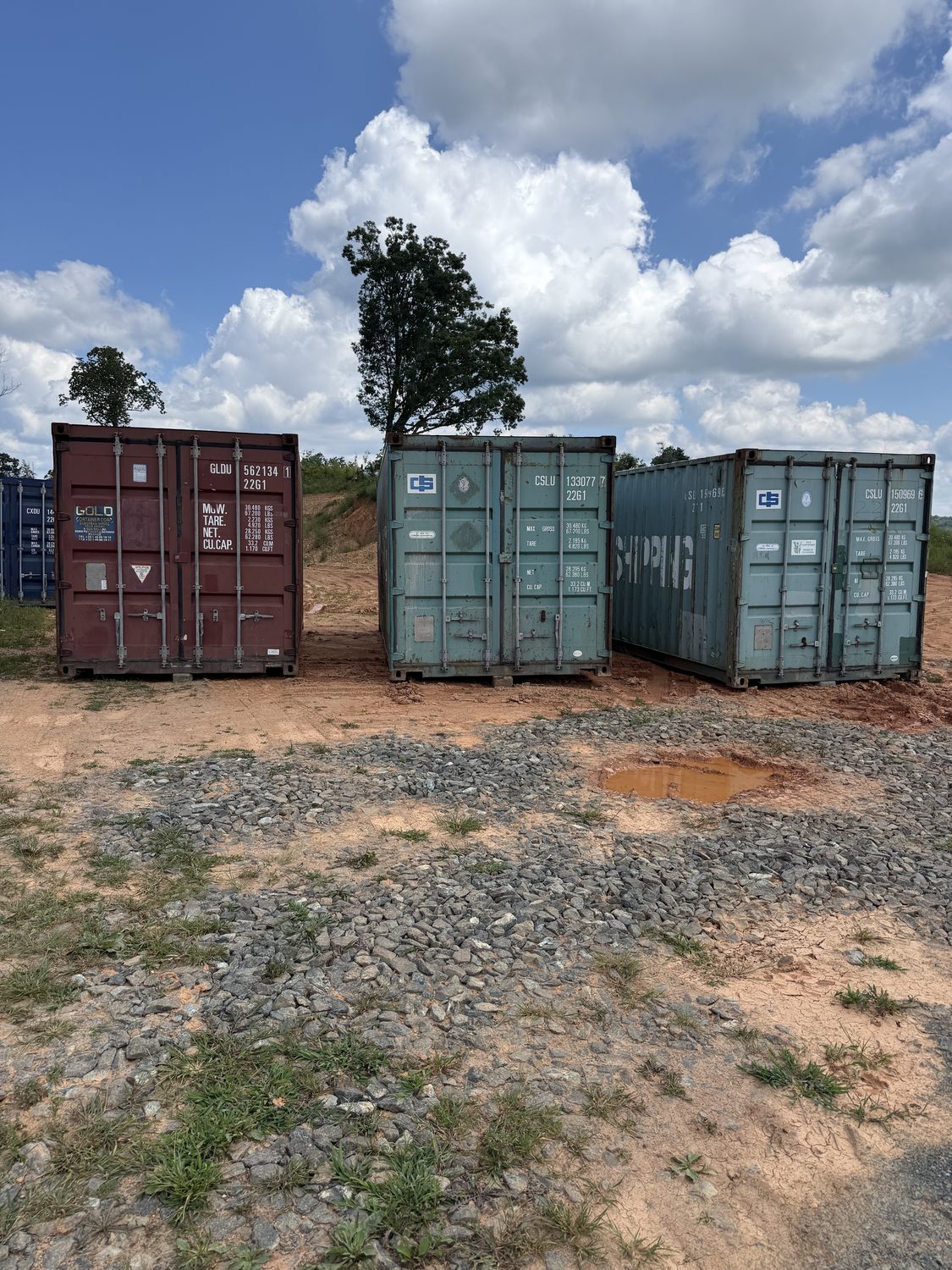
The City-County Inspections Division decides whether a shipping container set in Winston-Salem or the unincorporated county needs a zoning permit: the Winston-Salem/Forsyth County Unified Development Ordinance, searched in its October 1, 2026 text, has no rule that names one, and that office reviews building and zoning work across most of Forsyth County. That ordinance zones the City of Winston-Salem and the unincorporated county; Clemmons, Lewisville and Walkertown keep their own unified development ordinances, which the same Inspections Division enforces, while Kernersville, King and the part of High Point inside the county run their own zoning and inspections.
We found no zoning text posted by Rural Hall, Bethania or Tobaccoville, so start at that town's hall. We do not pull permits; whoever owns the parcel, or that owner's builder or electrician, applies for them.
Winston-Salem and the unincorporated county share one ordinance
The Winston-Salem/Forsyth County UDO names the ground it governs in its jurisdiction clauses: "the unincorporated areas of Forsyth County, North Carolina" and "the zoning jurisdiction of the City of Winston-Salem, North Carolina". Its section 1.4 adds that "Other incorporated areas in Forsyth County who control their own zoning jurisdictions have adopted their own Unified Development Ordinances."
Within the shared text, italics mark "rules solely applicable to land in the City of Winston-Salem" and underlining marks rules "solely applicable to land in Forsyth County". This guide reads the PDF the ordinance's own site posts as including "all text amendments adopted as of October 1, 2026", and the City warns that recent amendments "may or may not be reflected in the code currently available online", so confirm a section with City-County planning staff before you lean on it.
For a buyer, Winston-Salem and the unincorporated county read the same ordinance through the same desk. The Woodlawn yard sits 56 road miles from Winston-Salem, inside the zone where delivery and leveling cost nothing, and the Winston-Salem shipping container page has the drive.
The towns that keep their own codes, and who inspects them
The Village of Clemmons and the towns of Lewisville and Walkertown each keep their own unified development ordinance, and the City-County Inspections Division says it "completes plan review, issues permits, and enforces zoning regulations" under those codes along with the Forsyth County and Winston-Salem ones. Each still has its own planning contact: Clemmons and Lewisville run planning departments, and the City sends Walkertown callers to City-County Planning staff for "Walkertown Planning matters".
The town or city limits of Kernersville, King and High Point sit outside the Division's coverage, which runs "throughout Forsyth County, with the exception of the town/city limits of High Point, Kernersville and King". Kernersville enforces the state building code itself, keeps its own UDO, and requires its permits across the town limits and its ETJ. King's Planning, Zoning and Inspections Department covers the city, its Forsyth County part included, and our Stokes County container permit guide reads King's own section. High Point's own Development Ordinance and Inspections Services Department cover that city, most of it in Guilford County.
We found no zoning ordinance or zoning office posted on the websites of Rural Hall, Bethania or Tobaccoville, so the desk table below sends each parcel to its town or village hall first. Open every call with the town's name, because the town decides which code reads the box.
What the ordinance calls a storage trailer, and where it puts one
The Winston-Salem/Forsyth County UDO defines a storage trailer as "A structure originally constructed with wheels in order to be transported over the highways but now no longer transported and now converted to use as a storage structure." It adds that "A construction trailer at a construction site, uncoupled truck trailer, inoperable travel trailer, and an uninhabitable manufactured dwelling does not meet this definition."
Its Principal Use Table gives "Storage Trailer" a Z, a zoning permit from the Director of Inspections, in the GI General Industrial column and leaves the rest of that row blank. Its STRUCTURE entry is written standard by standard: "As used in the Salem Lake watershed protection standards", a structure is "anything constructed or erected which is above grade including a manufactured home and a storage trailer", while for the flood rules it is "a walled and roofed building, a manufactured home, or a gas, liquid, or liquefied gas storage tank that is principally above ground".
We found no shipping container named anywhere in the October 1, 2026 text; the word container turns up for donation containers, solid waste containers and a Winston-Salem standard for large retail sites. When a proposed use is not listed in the table, section 5.1.3 has the Director of Inspections "classify the use with that use in the Table most similar", and an undefined word takes "their common meaning". The first question for the desk is which use or structure the office reads a storage box as, because that reading picks the district and the permit.
Accessory structures under 5.3.1: yard lines, height and area
If the Inspections Division reads a box as an accessory structure, section 5.3.1 of the Winston-Salem/Forsyth County UDO places it; the ordinance defines that term as a structure "detached from a principal building on the same zoning lot, the use of which is customarily incidental to the principal building". An accessory use "must be located on the same zoning lot as the principal use to which it is accessory", so on a lot with no house or business yet, ask how the office reads a storage box at all.
On an interior lot, section 5.3.1 says an accessory structure "seventeen (17) feet or less in height and structurally detached from the principal structure" may stand in a required side or rear yard if no part of it is less than "seventy-five (75) feet from the front lot line nor less than three (3) feet from a side or rear lot line". Corner lots have their own version of the rule.
The area rule is a cap with an allowance under it. An accessory structure, section 5.3.1 says, "may not exceed five percent (5%) of the actual size of the zoning lot or the minimum permitted lot size of the zoning district, whichever is larger", yet "an accessory structure up to five hundred seventy-six (576) square feet in area shall be permitted in all districts", and a larger request may be considered through the Board of Adjustment's special use permit process. Accessory structures, section 5.3.1 adds, "may not occupy more than twenty-five percent (25%) of the area of the required yard", and one with any part within three feet of the principal building, or more than 17 feet tall, must meet all the zoning rules for the principal building.
Those figures are the ordinance's and the office's to apply; bring a plat marked with the spot you want.
Construction storage under 5.4.2(A), and the zoning permit that comes first
The Winston-Salem/Forsyth County UDO's list of temporary uses includes "Temporary structures or manufactured homes used for construction offices and storage areas on construction sites, for which the duration of such permits is limited to the actual time required for construction, plus the thirty (30) day period following the issuance of a certificate of occupancy".
Section 5.4.3 says "Any temporary use shall be established only after issuance of a zoning permit by the Director of Inspections for such use"; the permit states how long, it "may be renewed not more than twice, and such renewals may not exceed the period of time approved in the original permit", and unless otherwise specified no single permit or renewal runs past one year. Under section 3.2.14, a temporary use permit issues "only upon written agreement by the owner to remove the structures or uses upon expiration of the permit".
That list is open, "including but not limited to the following", and we found no entry in it for portable storage at a home or business, so a box parked for a move or a cleanout is a question for the Inspections Division. A box that leaves when the job ends is what a rental is for: a month-to-month rental runs $165 a month for a 20-ft or $235 a month for a 40-ft, and pickup inside the free delivery zone costs nothing.
When the UDO calls for a zoning permit, and the building permit that doubles as one
Section 3.2.18 of the Winston-Salem/Forsyth County UDO requires a zoning permit from the Director of Inspections before "The construction, reconstruction, erection, enlargement, relocation, or structural alteration of any building or structure or part thereof", and before "Any change of use of any building or land". The application goes in electronically with a statement of the intended use and "a plan so dimensioned or annotated as to show the proposed buildings and existing building, if any, in exact relation to lot lines".
The same section says "A building permit issued in accordance with the State Building Code shall serve also as a zoning permit", and a zoning permit is not valid unless "acted upon within one year of issuance or renewed after written application". Whether the state building code reaches the box is a separate question, read on our North Carolina permit guide for containers, and the same Inspections Division issues building permits for Winston-Salem and the county.
One permit can carry both reviews, and the box should not arrive before the paper does; our answer on whether you need a container permit in North Carolina lines up that call with the delivery date.
Flood maps dated June 10, 2026, and a removal plan for temporary structures
The Winston-Salem/Forsyth County UDO's flood chapter adopts the Forsyth County flood insurance rate maps "dated June 10, 2026" and requires a floodplain development permit "prior to the commencement of any development activities within special flood hazard areas"; for these rules, development includes "storage of equipment or materials". Applications go to the Floodplain Administrator, who is the Stormwater Director or a designee.
Before a temporary structure is permitted in a mapped flood area, the applicant submits, under section 8.1.3B.8, a written removal plan with a time period that "may not exceed three (3) months, renewable up to one year", who removes it, the "time frame prior to the event at which a structure will be removed", the removal contract, and "a location outside the special flood hazard area" to move it to. Accessory structures such as "sheds, detached garages, etc." there must meet a list of criteria, among them no use for "human habitation (including working, sleeping, living, cooking or restroom areas)", firm anchoring and flood openings; one "with a footprint less than one hundred fifty (150) square feet that satisfies the criteria outlined above does not require an elevation or floodproofing certificate".
The chapter's list of initial flood maps also names the towns of Bethania and Rural Hall and the Village of Tobaccoville, so for a mapped parcel in one of them, ask which floodplain administrator reviews it. The City's flood insurance page points owners to the Stormwater Division at City Hall, 101 North Main Street, or a floodplain manager through CityLink at 336-727-8000, free of charge. Our answer on whether a container can go in a floodplain deals with the ground itself; a removal plan is easier to write while the spot is still a choice.
The City-County desk, the town halls and what to ask each
The City-County Inspections Division takes the container question for Winston-Salem and the unincorporated county: Bryce A. Stuart Municipal Building, 100 E First Street, Winston-Salem, 336-727-2624, Monday through Friday, 7:45 a.m. to 4:45 p.m., with every permit applied for electronically. For the zoning district, ask the Land Use Administration team, which keeps the zoning maps, at 336-747-7064; to see which town a parcel sits in, open the Forsyth County Municipalities Map on the City-County maps page.
| Parcel | Zoning code | Building permits | First call |
|---|---|---|---|
| Winston-Salem or the unincorporated county | The joint UDO | City-County Inspections Division | Inspections Division, 336-727-2624 |
| Village of Clemmons | The Village's own UDO | City-County Inspections Division | Village Hall, 3715 Clemmons Road, 336-766-7511 |
| Town of Lewisville | The town's own UDO | City-County Inspections Division | 6510 Shallowford Rd, (336) 945-5558 |
| Town of Walkertown | The town's own UDO | City-County Inspections Division | City-County Planning staff, 336-747-7040, or Town Hall, 336-595-4212 |
| Town of Kernersville, its limits and ETJ | The town's own UDO | Kernersville Development Services | Development Services, (336) 996-7166 |
| City of King, its Forsyth County part included | King's own code, on our Stokes County guide | King Planning, Zoning and Inspections | (336) 983-8265 |
| City of High Point, its Forsyth County part | High Point's Development Ordinance | High Point Inspections Services | 211 South Hamilton St., 336-883-3151 |
| Town of Rural Hall | None posted that we found | Ask Town Hall | 423 Bethania Rural Hall Rd., (336) 969-6856 |
| Town of Bethania | None posted that we found | Ask Town Hall | Town Hall, 5385 Ham Horton Lane, 336-922-4744, Monday to Friday, 9 a.m. to 1 p.m. |
| Village of Tobaccoville | None posted that we found | Ask Village Hall | Village Hall, 4260 Tobaccoville Road, (336) 983-0029, Monday to Friday, 8 a.m. to 5 p.m. |
From each office's own page.
Have the parcel number, the district if known, which box and for how long, and any mapped flood area ready, then ask how the office reads the box and which permit follows. The truck, the pad and neighborhood covenants are on our permits and placement page for Winston-Salem.