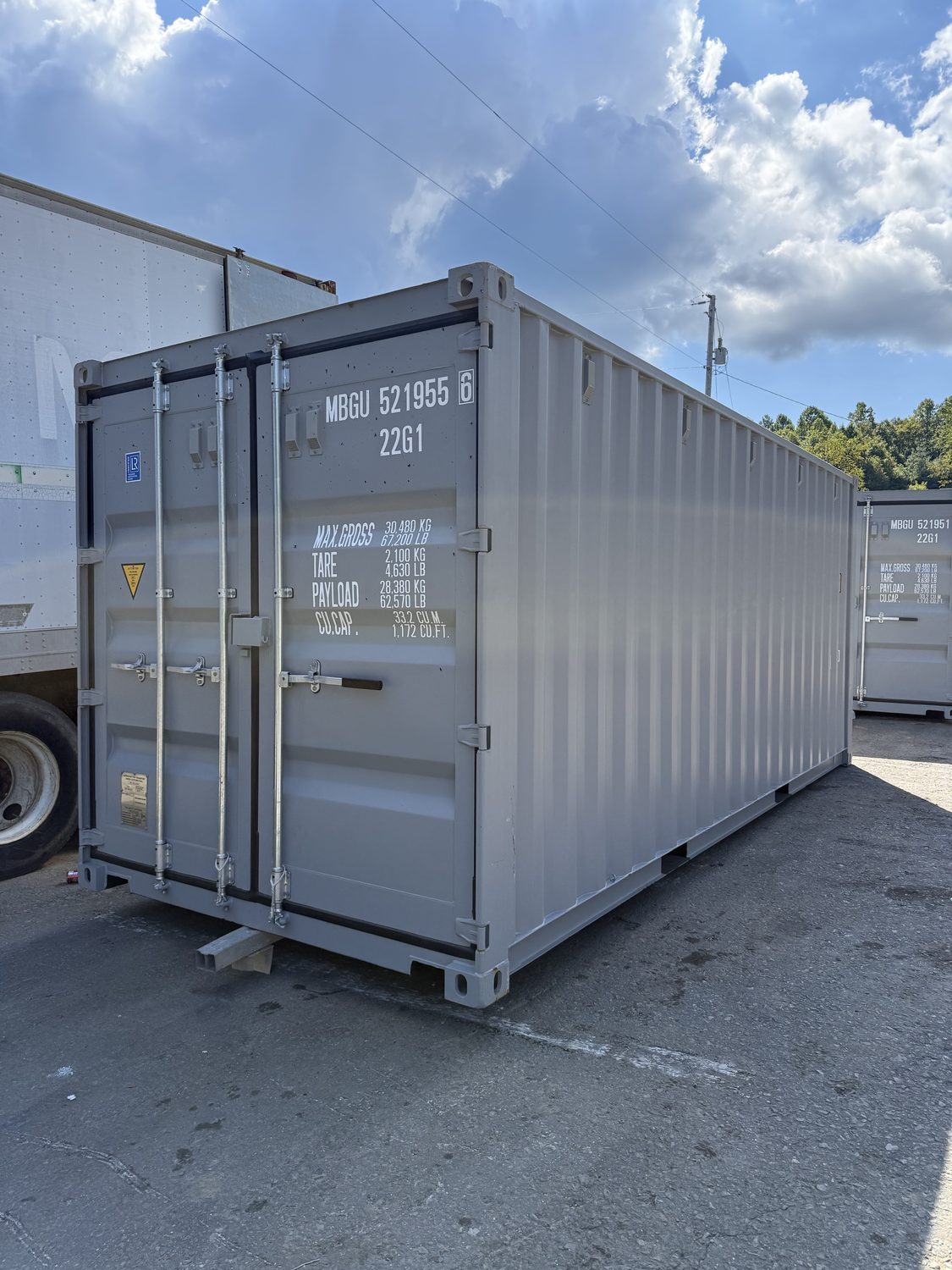
Cargo doors are the best doors a container has and the worst doors a workshop has. They seal beautifully, they lock like a bank, and they were designed to be opened at a port a handful of times in a container's working life. If you are opening the box twice a day to get a mower out, they are the wrong tool.
A roll up door is the fix. It is the single most requested modification our shop cuts, and it is the one that changes how a container feels more than any other. This page covers what installing one actually involves, where it can go, and what you trade away to get it.
You are cutting a hole in a structural wall
A shipping container is strong because it is a closed steel box. The corrugated walls are not decoration, they are what stops the box racking out of square when it is lifted, stacked, or set down on ground that is not perfectly level. Cut an opening into one and you have removed some of that stiffness, which is why a roll up door is a fabrication job rather than a purchase.
The work is in the framing. We cut the opening, then weld in a steel header across the top and jambs down both sides so the load that used to travel through the wall panel travels around the new opening instead. The roll up assembly mounts to that frame, not to the corrugation. Done properly the container is still square, still lockable, and still moves on a truck the same way it did before.
Everything happens in our own shop in Woodlawn. We cut, weld, wire, and finish here, so the person who frames your opening is the person you talked to about the job. Nothing gets farmed out.
End wall or side wall, and why it matters
There are two normal places for a roll up door, and the choice is usually settled by how the container will sit on your ground rather than by preference.
In the end, replacing the cargo doors
The cargo door end is already an opening, already framed by the corner posts, and already the strongest part of the box for this purpose. Putting the roll up there is the cleanest structural job. You give up the cargo doors themselves, which means you give up their weather seal and their security, and you gain a door you can open with one hand in ten seconds.
In the side, keeping the cargo doors
A side opening leaves the cargo doors intact on the end, so you keep full width access when you need to load something long and you gain a daily door where you actually walk up to the container. This is the better answer when the box is backed up to a treeline or a fence and the end is not reachable, and it is the more involved cut, because that side wall was doing structural work the corner posts were not.
We will ask how the container is going to be positioned before we quote either one. A door in the wrong wall is an expensive thing to discover after delivery.
How big a door will fit
The ceiling is the constraint people underestimate. A standard container is eight feet six inches tall on the outside, and by the time you account for the roof structure, the header, and the barrel the door rolls onto, the clear opening height is meaningfully less than the height of the box.
That matters if you are driving something in. A zero turn mower fits comfortably. A tractor with a rollbar up usually does not, and the answer there is either folding the bar or starting with a high cube instead of a standard container.
- A standard 20 or 40 ft container gives you a usable drive in opening for mowers, carts, bikes, ATVs, and general shop traffic.
- A high cube adds a foot of exterior height, and that foot goes almost entirely into headroom you can use.
- Width is the easier dimension. The container is eight feet wide outside, and a roll up can take up most of the usable interior width in the end wall.
- Tell us what has to drive through the opening and we will spec the door around that, not around a catalogue size.
If headroom is the whole point of the project, read the 20 ft high cube and 40 ft high cube pages before you settle on a size. It is cheaper to start with the taller box than to discover the limit after the door is welded in.
What you give up
We would rather tell you this before we cut than have you work it out in February.
Weather sealing
Cargo doors seal against a heavy gasket and clamp shut under real pressure from four locking bars. A roll up door seals against brushes and a bottom astragal. It is a good seal and it keeps weather out, but it is not the same seal, and in wind driven rain or fine blown snow a roll up is the part of the box most likely to let something past.
Security
Cargo doors with a welded lockbox are genuinely hard to defeat. A roll up door is a rolling steel curtain with a latch, and while we can add hasps and mounts to improve it, it is the softer opening. If the container is going somewhere remote and unwatched, that is worth weighing.
Wall space
The door has to roll up onto something, and that barrel sits inside the container above the opening. You also lose the wall the door occupies for shelving. On a 20 ft box in particular, a roll up in the end plus racking down both sides can leave less usable wall than people picture.
The jobs a roll up door is usually part of
A roll up rarely ships alone. Most builds pair three or four modifications, and the door is the anchor the rest gets specified around.
- Equipment garage. Roll up door plus an entry ramp, so mowers and machines drive straight in without a lift.
- Workshop. Roll up door for light and access, lighting and outlets roughed in, and shelving down the far wall.
- Retail or pop up. Roll up as the storefront, with paint and vinyl signage so the container works as the building and the sign at once.
- Jobsite storage. Roll up for speed during the day, with the cargo doors kept on the other end and locked for anything that stays overnight.
You can put a roll up door on a container you buy from us or on one you rent month to month, and we can also cut one into a container you already own, provided it is structurally sound and wind and water tight. We inspect first and tell you honestly what the box can and cannot take.
Simple single mods often turn around in a few days. A roll up door combined with insulation, electrical, lighting and finished walls takes longer, usually one to a few weeks depending on scope and parts. You get a real timeline in writing with the quote, before any steel is cut.