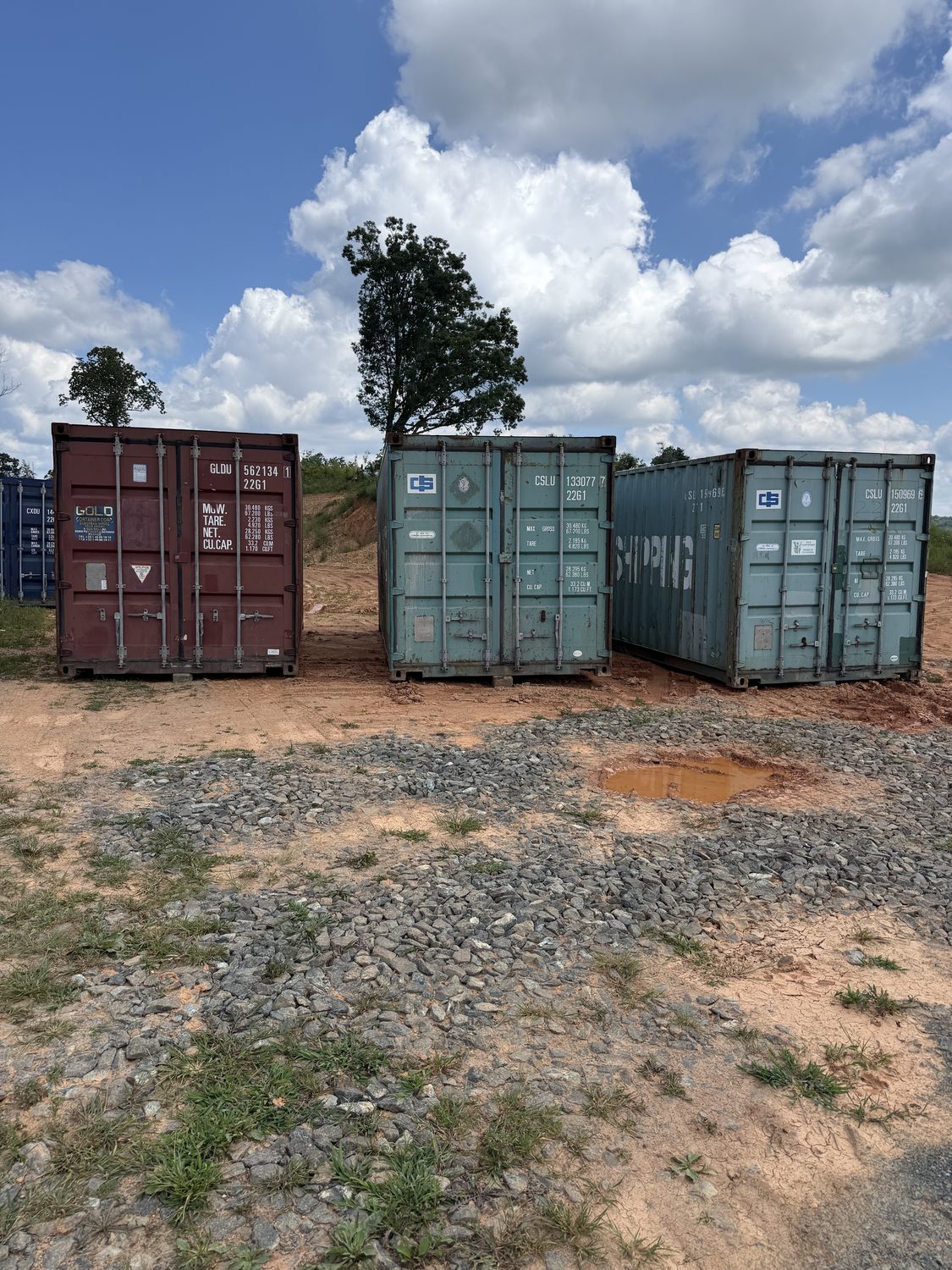
A twenty foot container gives you roughly a hundred and sixty square feet of floor. Stack things on that floor and you can reach maybe the front third of it before the rest becomes archaeology. The container is not full. It is just unusable, which is worse.
Shelving is the mod that fixes the geometry. It moves storage onto the walls, keeps a walkway open down the middle, and makes the back of the container as reachable as the front. This page covers the two systems our shop fits, how they attach to corrugated steel, and how to think about the aisle.
The one real decision
The hub puts it in a single line: welded or bolt in shelving and racks that turn empty wall space into organized storage. That choice is most of the specification, and it comes down to whether you expect the layout to change.
Welded
Welded shelving is fabricated into the container and becomes part of it. It is the stronger system by a wide margin, because the load path runs straight into the container's own structure rather than through fasteners. It does not shift, it does not rattle down the road if the container gets moved, and it will not work loose over years of being loaded and unloaded.
The cost is permanence. Welded shelving is where it is. If your storage needs change in three years, changing the racking means cutting it out, and that is a shop job rather than an afternoon.
Bolt in
Bolt in racking mounts to fixings set into the container and can be unbolted, moved and reconfigured later. That flexibility is genuinely useful when you do not yet know what you will be storing, when the container serves more than one season's purpose, or when the box is rented and will eventually go back.
It gives up some capacity and some rigidity compared to welded, and it wants checking occasionally, the way any bolted assembly does.
Why you cannot just screw into the wall
Container walls are corrugated, and that corrugation is structural. The peaks and valleys are what give a thin steel panel its stiffness, in the same way a folded sheet of paper will stand up when a flat one will not.
Two things follow from that. The first is that the wall is not flat, so anything mounted to it either follows the corrugation or needs something to bridge across it. The second is that the corrugated panel itself is thin. It is strong in the direction it was designed for, which is resisting racking across the whole panel, and it is not designed to carry a point load hanging off the middle of it.
So shelving does not hang off the wall panel. It is built against the container's actual structure, and the corrugation is spanned rather than loaded.
- Vertical uprights transfer load down to the floor, where the container's underframe is happy to take it.
- Wall connections locate and steady the rack rather than carrying the weight of what is on it.
- Anything heavy sits low. That is true of any racking, and it matters more in a box that gets picked up and moved.
- Nothing gets fixed in a way that compromises whether the container stays wind and water tight.
That last point is the one to watch with self installed shelving. Every fastener driven through an exterior wall is a hole in a box whose whole value is being sealed. Our shop mounts shelving without creating those.
Eight feet wide is less than it sounds
A container is eight feet wide on the outside, and usable interior width is a little under that. It is the dimension that governs your layout, and it is the one people plan around last.
Shelve both walls to a normal depth and the aisle left in the middle is comfortable for a person carrying a box, and tight for anything else. Shelve both walls deep and you have a corridor you turn sideways in. There is no way around the arithmetic, so it is better to do it before the racking is welded in.
How people usually resolve it
- Deep on one wall, shallow on the other. The common answer. Bulk on one side, small parts and tools opposite, and a usable aisle that stays usable.
- Both walls shallow. Best for lots of small items, tools, parts, supplies, where you want everything visible at a glance.
- One wall only. Where the container also has to swallow something big, a mower, a quad, pallets, and the open side is the parking space.
- Shelving high, floor kept clear. Racking above waist height on both walls with the floor left open, so the container still takes a pallet down the middle.
On a 40 ft container the aisle question is the same but the walk is twice as long, which is where a personnel door partway down the side starts to look like a good idea rather than a luxury.
Shelving is also moisture management
There is a reason shelving turns up in the same conversation as ventilation, and it is not just organisation.
The floor of a container is the surface closest to the ground, the surface where any water that does get in ends up, and the surface that condensation runs down to. Anything sitting directly on it, cardboard boxes especially, is in the worst spot in the box. Get the same contents onto a shelf with air around them and most of the problem goes away.
Air movement is the other half. Contents stacked tight against a wall trap air behind them, and trapped air against cold steel is where condensation likes to happen. Racking that holds contents slightly off the wall lets air circulate behind, which is the same principle as the high and low vent placement on the ventilation page.
What shelving usually ships with
Racking is rarely the only mod on a container, and the pairing tends to follow the use.
- Workshop. Roll up door, lighting, outlets and shelving. Racking down the far wall so the door end stays clear for working.
- Dry and secure storage. Vents, a personnel door and the welded lockbox, with shelving deciding whether the space is actually usable.
- Farm and feed. Heavy low racking for feed and supplies, generous ventilation, and everything off the floor.
- Parts and supply. Shallow shelving both walls, good lighting, and a walk in door so you are not swinging cargo doors for one part.
We fit shelving in containers you buy from us, containers you rent month to month, and containers you already own if they are structurally sound and wind and water tight. We do not publish load ratings on this page, because the honest answer depends on the span, the system and what you are putting on it. That figure belongs in your written quote, where it is specific to your build.
Tell us what is going on the shelves and roughly how heavy it is. That is the information that decides welded or bolt in, how deep, and how the uprights get spaced.