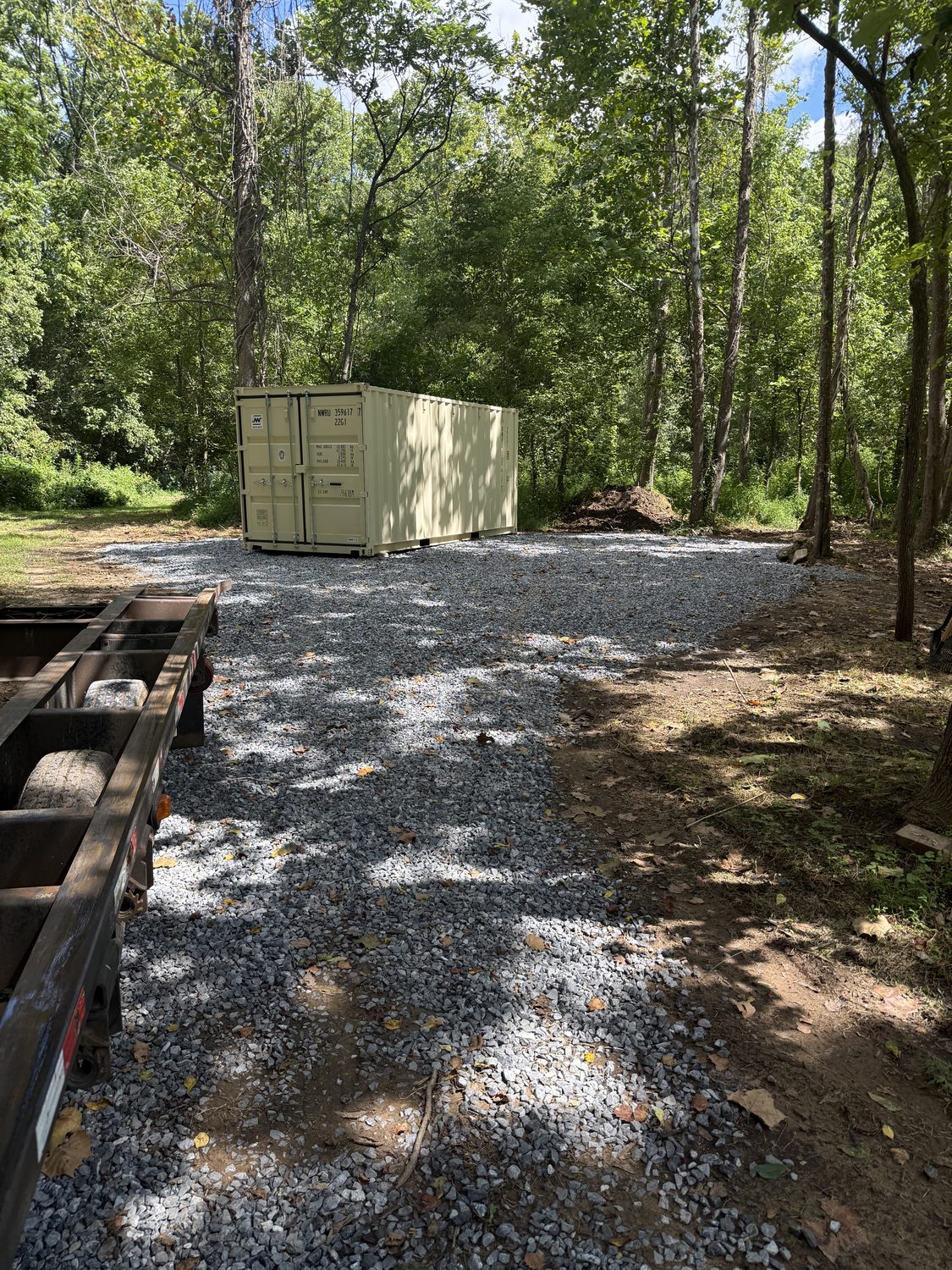
Settle the biggest question first, because it decides everything after it. What leaves our yard in Woodlawn is a storage container. It is not a dwelling and we do not sell it as one. Virginia leaves a container outside the building code when it is placed on a site and used for storage, and that exemption follows the use, not the steel and not how long it sits. A box on your tract for twenty years is still storage. The day somebody starts living in it, it is not. If that was the picture, read can I live in a storage container and are container homes legal here first.
This page assumes you have that answer and still want a box out there: gear, feed, corn, stands, cameras, four-wheelers and side-by-sides locked and dry from one season to the next, plus somewhere to get out of the weather during a day hunt. Hunters in Carroll, Grayson, Floyd and Patrick counties, and in Ashe, Alleghany and Wilkes across the North Carolina line, ask the same four things, and a back yard asks none of them. Whose ground is it. Can the truck get there. Where does power come from. What happens over the nine months nobody is out there.
What the box is actually doing out there
A container on a tract is a locked, dry, rodent proof room you did not have to build, sitting where the work happens rather than at the far end of a drive back at the house.
- The off season. Stands, blinds, cameras, ladders, totes of gear and a season's worth of corn, in one place rather than four.
- Machines. A four-wheeler or a side-by-side out of the weather and behind a locked door between trips.
- A dry spot to work. Somewhere to pull a wet coat off and sort gear during a day hunt.
- Feed, with one condition. Steel beats a wood feed room on rodents outright, but a sealed box has to breathe. Storing feed and our farm and land page handle that.
Stock is two sizes. A 20-ft is about 160 square feet and a 40-ft about 320. Pick by the largest thing going inside, then leave room to walk past it. Container sales has the grades.
Owned land and leased ground are not the same decision
On land you own this is between you and your county. On a lease it is a three way arrangement, because the container is your personal property on ground that belongs to somebody else. Have the conversation before the truck is scheduled, and get the answers in writing.
- Does the written lease let you place a structure or store equipment on the tract at all. Plenty of leases are silent, and silent is not yes.
- Is the landowner agreeing to the specific spot, or only to the general idea.
- Can you take it off at the end of the term, and how much notice do they want.
- What happens if the lease is not renewed, or ends partway through a season.
Two facts make that list worth working through. Moving a container after it is set is a full second delivery on the schedule, not something a crew nudges with a strap, and the new spot gets checked for clearance and ground the way the first one did, as moving a container after it is set explains. And lease length feeds the rent versus buy question: a tract you could lose at renewal makes a rental easier to walk away from than a container you own behind somebody else's locked gate.
The county is a separate question from the landowner
Permission from the person who owns the dirt is not permission from the county, and the building office and the zoning office are not the same office. Virginia's building code leaves a container alone when it is used as storage, at 13VAC5-63-20 Section 102.3 Exemptions item 11, but zoning is a separate local layer that changes at the county line: some counties in this corner of Virginia have no countywide zoning at all, and the next one over names containers directly. In North Carolina assume a permit, because the small accessory building exemption, GS 160D-1110(c), caps at 12 feet in any dimension and never reaches a 20-ft or 40-ft box. Start with do I need a permit, then Virginia, Carroll County or Grayson County. We do not pull permits; they attach to the parcel.
Getting a truck to the spot on a hunting parcel
This is the part that most often changes the plan, so walk it early. The container rides in on a tilt-bed truck and slides off onto blocks set level, which means the truck has to line up straight on the spot: about 65 feet of straight pull-in for a 20-ft, about 95 feet for a 40-ft, over ground firm enough to carry a loaded truck in and back out again.
- The gate. How wide is the opening, and is there room to line up straight before it rather than cranking through it on the turn.
- Who unlocks it. A locked gate needs somebody with a key standing there when the truck arrives, which is the detail a back yard delivery never has to think about.
- The lane. A track that carries a side-by-side all fall can turn to grease after a wet spell, and ground going soft under the wheels reschedules more deliveries than anything else on a tract. See mud season.
- Overhead. Limbs that clear a pickup do not clear a loaded truck carrying a container, and a wooded lane is nothing but limbs.
- The spot itself. Firm, level enough, with room to get back out. Build up on a crowned gravel pad rather than digging in: the foundation guide and should I anchor in an open field have the order of operations, hardware last.
None of that is special pleading for hunting land. It is the standard checklist with the tract details filled in: delivery preparation is the full version and our tree farm answer the closest published case. That whole trip is included out to 75 road miles from the yard, leveling and all; how far free delivery goes has the zone.
Power on ground that has no service
Most tracts have no meter anywhere on them, and the two honest routes are the same two we publish for any field container: a buried feed from a service that already exists on the property, or a small solar setup that runs lights and keeps a battery charged. Distance decides between them more than anything else.
So be straight about the load first. Light, so you can find a stand in the dark, and a way to charge things, is one project. A compressor, a heater or a pump wants a real feed, and a trench across a field is its own job. Running power to a field container walks the distance question and says where a small solar setup runs out.
Where our work stops does not bend for a remote parcel. Our shop roughs it in before the box ships: sub-panel, conduit, boxes, outlets, switches and fixtures, to the plan you bring us. A licensed electrician you hire makes the final connection and handles the inspection in your jurisdiction. We do not pull permits, we do not energize anything, and we do not install solar panels, batteries or charge controllers. What lands on your tract is wiring waiting for somebody else to connect.
Nine months with nobody looking at it
Start with what is already handled. Every container we sell or rent leaves here with a welded lockbox on the doors, included, and it is the same steel on a back parcel as on a jobsite in town.
Now the honest gap. Our standing advice for rural placement is to set the box near a house, a driveway or the light on a barn, where headlights and foot traffic already pass. A hunting tract usually has none of those, so what that advice is really about, how easily somebody could work on your doors unseen and unhurried, has to be answered another way.
- Think about vehicle access, not distance from town. A box a truck can back straight up to is a different proposition from one behind a gate at the end of a lane. Do thieves target rural containers makes that case in full.
- Point the doors deliberately. Decide which way they face before delivery day, because turning the box afterward is another truck visit.
- Do not leave everything out there all summer. The most portable, most valuable items can ride home at the end of the season.
- Cameras want planning, not drilling. A conduit path and the mounts themselves go in at the shop, which is the only stage where a camera can be added without cutting fresh holes in a box that is already weathertight, and a monitored camera still needs power on site and a signal. See cameras on a container and container security.
The other thing nine months does is quieter than theft. A box shut up and unheated through a summer breathes moisture up through the floor, and cold steel at night is where that moisture collects, so a container that sits closed for a season wants ventilation specified with the build rather than added in September. Vents and ventilation and the condensation guide explain what to ask for.
What our shop will build for a tract box, and what it will not
All of it happens in Woodlawn before the container goes on a truck, because the alternative is the same work in an open field a long way from an outlet.
What we will do
- Cutting and welding, including a personnel door on the side, so getting in and out does not depend on the big doors at the end. See man doors.
- Windows, vents and shelving, laid out around what actually goes in there.
- Insulation, if the box gets worked in during cold weather. Insulation makes that case better than this page can.
- Rough-in electrical and welded camera mounts with a conduit path, as above.
What we will not do
- Plumbing, a well, or a septic tie-in on raw acreage.
- Permit filing or zoning applications of any kind.
- The final electrical connection or the inspection that follows it.
- Anything meant to turn the box into a place somebody lives. That is where this page started.
There is no modification price sheet on this site, deliberately, because two jobs described with the same word are rarely the same job. Send the list and a written itemized quote comes back. The workshop conversion guide is the deep version of how a build sequences.
The rent or buy call on a hunting tract
Both are normal, and on hunting land the deciding factor is usually tenure rather than arithmetic. A used cargo-worthy 20-ft is $3,200 delivered and a 40-ft is around $4,900, out the door, with the drive, the blocks it lands level on and the welded lockbox already inside the number. Renting is $165 a month for a 20-ft and $235 a month for a 40-ft, month to month, no contract.
Our published rule of thumb is that once a container stays past about 18 to 20 months, buying usually comes out ahead. A need that only shows up in the fall looks like the obvious case for renting, and it often is not, because the seasons keep coming and every return trip is another delivery to book and another pass at getting the lane and the pad ready. How long people rent works that arithmetic and buy versus rent has the comparison.
If you rent first and later decide you would rather own it, say so. In many cases we can credit a portion of the rent you have already paid toward buying it outright, and the specifics belong on a call about your rental rather than on a web page. Container rentals has the current rates.